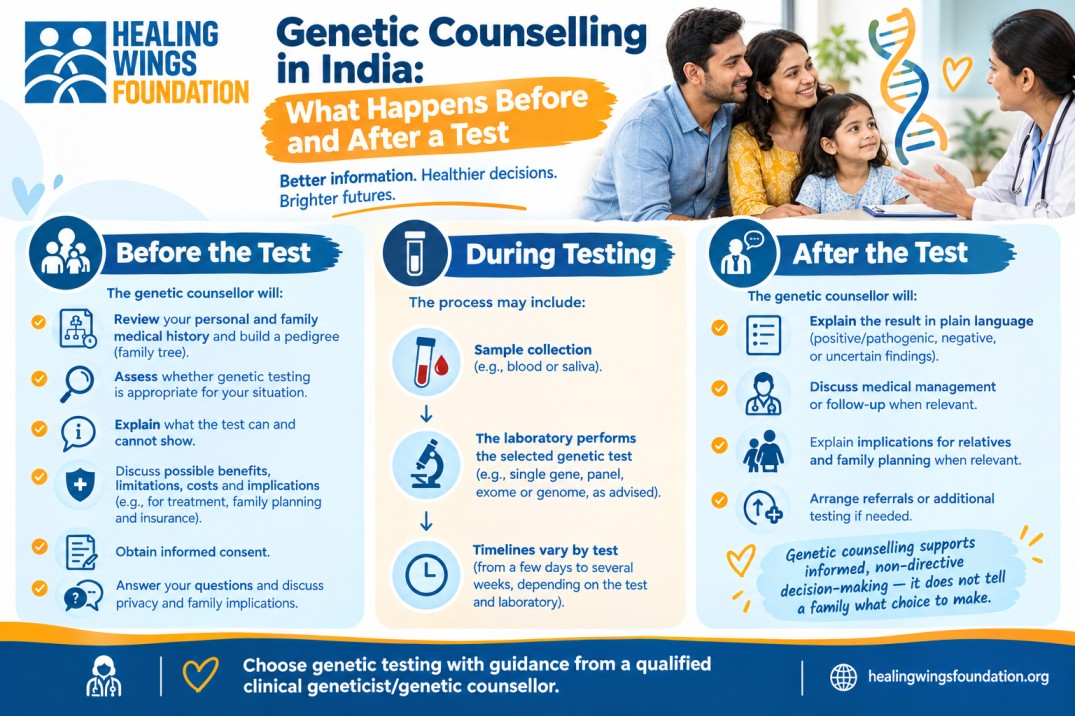
A genetic test result is more than a lab report. It can change how a family understands a child’s health, plan for the future, and think about relatives. Genetic counselling is the conversation that helps families make sense of all this, before the sample is taken and after the result comes back. It is a key part of early diagnosis, yet many families in India are never told it exists.
What is genetic counselling?
Genetic counselling is a communication process that helps individuals and families understand and adapt to the medical, emotional, and family implications of a genetic condition. It is usually led by a trained genetic counsellor, often working with a clinical geneticist or pediatrician.
A counsellor does not tell you what to decide. Their role is to explain the facts clearly, help you weigh the options, and support the choices that are right for your family.
Who can benefit?
Counselling is useful if:
Your child has developmental delay, seizures, multiple birth differences, or an unexplained condition
A genetic test is being considered or has been done
A genetic condition runs in the family
You’ve lost a pregnancy or a child to an unexplained cause
Parents are related by blood
You’re planning a pregnancy and have a family history of a genetic condition
You’ve received a result that is unclear or hard to understand
Before the test: pre-test counselling
A good pre-test session usually covers:
Your story. The counsellor takes a detailed medical history and draws a family tree (pedigree), often going back three generations.
Why testing is being considered. What question the test is meant to answer.
Choosing the right test. Whether a single-gene test, panel, microarray, or exome sequencing makes the most sense. See our genetic testing guide for patients and families for the options.
Possible results. A positive result, a negative result, and an uncertain one (a variant of uncertain significance) can all happen, and each means something different.
Limits of the test. No test can find every cause.
Other considerations. Cost, how long results will take, who else in the family may need testing, privacy of the data, and possible unexpected findings.
Consent. You decide whether to go ahead, and you can say no or take time to think.
After the test: post-test counselling
When results are ready, a follow-up session should cover:
What the result means in plain language. What was found, and what it does and doesn’t tell you about your child’s condition.
What happens next. Medical follow-up, specialist referrals, therapies, and monitoring.
Recurrence and family risk. Whether the change was inherited or new, the chances of it happening again in another pregnancy, and whether relatives should be offered testing.
Reproductive options. For families who wish to discuss them, the options available for future pregnancies.
If the result is negative or uncertain. What can be done next, such as further testing, and the possibility of reanalysing the data later as knowledge grows.
Emotional support. Guilt, grief, relief, and anxiety are all common. A counsellor can help you talk about them and point you to support.
Our article on what to expect after a rare disease diagnosis can help you plan the next steps.
The Indian context
Genetic counselling in India faces some real challenges, and it helps to know them:
Few trained counsellors. Published reviews note that the number of genetic counsellors is limited, so people in remote areas and economically weaker communities often have less access.
Counselling often happens after the test. Industry experience reported by one large Indian genetic lab suggests most counselling cases are post-test, and that the lack of pre-test counselling causes many of the problems counsellors face.
Language and culture matter. Good counselling should be in a language you’re comfortable with and sensitive to family and cultural concerns.
Tests ordered online or directly by consumers. Reports from such tests may not be clinically reliable, and results should be reviewed with a doctor or counsellor.
If a lab sends you a report without explaining it, ask for a counselling session or a referral to a genetics clinic. Hospitals with genetics departments, medical college genetics units, and some diagnostic labs offer counselling, and many counsellors now offer online sessions.
How to find a qualified counsellor
Ask your pediatrician or neurologist for a referral to a clinical genetics department.
Ask the lab whether counselling is included and who provides it.
Ask about the counsellor’s training and certification. India has a certifying body, the Board of Genetic Counselling, India, though availability varies.
Ask whether sessions are available in your language and whether online consultation is possible.
How to prepare for a session
Write down your child’s symptoms, milestones, and the age when each concern began.
Bring earlier test reports, scans, and medical records.
Gather family history: relatives with similar health problems, early deaths, miscarriages, and whether parents are related.
Prepare your questions. Bring a family member for support if you can.
Ask whether you can record the session or take notes, since it is a lot to absorb.
Questions worth asking
What can this test tell us, and what can’t it tell us?
What are the possible results, and what would each mean for treatment?
Does anyone else in the family need to know or be tested?
Who will see my child’s genetic data, and how is it stored?
If the result is negative or uncertain, what are the next steps?
Where can we find support from other families?
You don’t have to do this alone
A genetic condition affects the whole family, not just one person. Talking to a counsellor, connecting with other families, and getting help to speak up for your child can make the journey easier. Explore our patient advocacy support resources to find guidance and community.
References
Genetic counseling and ethical issues in genetic counselling. Indian Journal of Medical Research. PMC3237255
Purandarey HM. Importance of genetic counseling in medical practice: a narrative review. wjwch.com
Malhotra H, Verma A, et al. Genetic counseling, testing, and management of HBOC in India: an expert consensus document from the Indian Society of Medical and Pediatric Oncology. JCO Global Oncology. PMC7392772
Narayanan DL, Girisha KM. Genomic testing for diagnosis of genetic disorders in children: chromosomal microarray and next-generation sequencing. Indian Pediatrics. 2020;57(6):549-554. doi:10.1007/s13312-020-1853-3
This article is for general education and isn’t a substitute for medical advice. Please talk with your child’s healthcare team or a qualified genetic counsellor about your specific situation.
