Every parent watches for the small moments — the first smile, the first wobbly steps, the first word. So when a child seems to be taking longer to reach these moments than other children the same age, it's natural to feel worried. You may find yourself searching online late at night, wondering whether this is simply a normal variation in development, or something that needs medical attention.
It's important to understand this clearly from the start: a child not meeting developmental milestones does not automatically mean something is seriously wrong, and it certainly does not mean a rare genetic disorder is the cause. Children develop at different paces, and many delays resolve on their own or respond well to early support. At the same time, in a smaller number of cases, developmental delay can be an early sign of an underlying medical or genetic condition — which is exactly why noticing delays and having them properly evaluated matters.
This article is meant to help you understand what developmental milestones are, what it can mean when they aren't met on the expected timeline, and when it may be worth speaking with a doctor about further evaluation, including genetic testing. It is not meant to diagnose your child or replace a consultation with a qualified healthcare professional.
What Are Developmental Milestones?
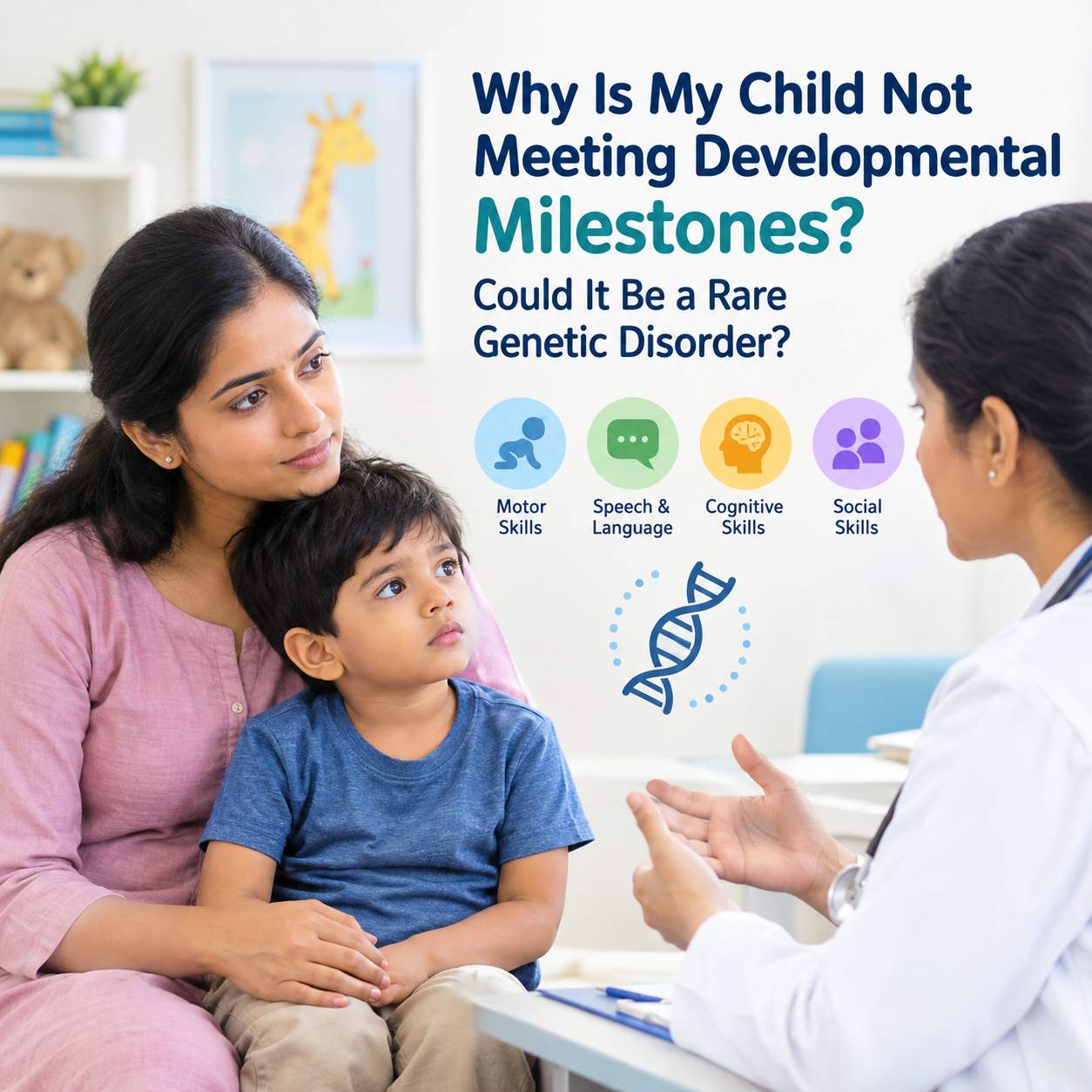
Developmental milestones are skills or behaviors that most children develop within a general age range. They're typically grouped into four broad areas:
Motor skills — such as rolling over, sitting, crawling, walking, or later, running and climbing.
Speech and language — such as babbling, saying first words, forming simple sentences, and understanding instructions.
Cognitive skills — such as problem-solving, recognizing objects, and understanding cause and effect.
Social and emotional skills — such as smiling responsively, making eye contact, and interacting with caregivers or other children.
Health organizations such as the U.S. Centers for Disease Control and Prevention (CDC) and the American Academy of Pediatrics (AAP) publish general milestone checklists for different ages, which pediatricians use as a reference point during routine check-ups. It's worth remembering that these checklists describe a typical range, not a strict deadline — children can reach the same milestone weeks or even months apart from one another and still be developing normally.
What Does It Mean When a Child Is Not Meeting Milestones?
When a child doesn't reach an expected milestone within the typical age range, it's generally referred to as a developmental delay. This term simply describes an observation — that a specific skill is taking longer to develop than expected — not a diagnosis or a cause.
Developmental delay can appear in one area (for example, only speech and language) or across multiple areas at once (for example, motor skills and social interaction together). A delay in a single area is often different in significance from delays affecting several areas simultaneously, which is one of the reasons a doctor's assessment is more reliable than comparing notes with other parents or relying on general online checklists alone.
It also helps to know that occasional, mild delay is common and often temporary — related to factors like premature birth, temporary illness, or simply individual pace of development. Persistent or multi-area delay is what typically prompts a more detailed look.
Common Reasons for Developmental Delay
Developmental delay has many possible explanations, and most of them are not related to rare genetic conditions. Common contributing factors include:
Premature birth, which can shift a child's developmental timeline compared to their actual age.
Hearing or vision difficulties, which can affect speech, language, and social development if undetected.
Limited early stimulation or interaction, particularly in the areas of language and social skills.
General medical conditions, such as chronic illness or nutritional deficiencies, that can temporarily slow development.
Environmental or psychosocial factors, including stress or disruption at home.
Individual variation, where a child is simply developing certain skills at their own pace without any underlying issue.
In many cases, once the underlying factor (such as a hearing issue) is identified and addressed, developmental progress catches up. This is one of the key reasons pediatricians recommend evaluation rather than a "wait and see" approach when delay is persistent or affects more than one area.
Could a Rare Genetic Disorder Cause Developmental Delay?
In a smaller subset of children, developmental delay can be an early indicator of an underlying rare genetic disorder. According to the U.S. National Institutes of Health's Genetic and Rare Diseases Information Center (GARD), thousands of recognized rare diseases exist, and many of them can present with developmental delay, alongside other features that may involve growth, physical features, muscle tone, or organ function.
It's important to be clear about what this does and doesn't mean:
Most developmental delay is not caused by a rare genetic disorder.
However, when delay is significant, affects multiple developmental areas, or occurs alongside other unusual signs (discussed below), a genetic cause becomes one of the possibilities a doctor may want to rule in or out.
Identifying a genetic cause, when one exists, isn't about labeling a child — it's about understanding the underlying condition well enough to plan the right kind of support and medical care going forward.
If you'd like to understand the difference between a child who is developing more slowly than expected in a consistent way, versus a child who appears to lose skills they'd already gained, our related article, Developmental Delay vs Developmental Regression: When Should Parents Be Concerned?, looks at that distinction in more detail.
Signs That May Require Further Medical Evaluation
While every child's pace is different, certain patterns are generally considered worth discussing with a pediatrician sooner rather than later:
No babbling or limited response to sounds by around 12 months
Not walking independently by around 18 months
Very limited vocabulary or difficulty combining words at an age when most children do
Loss of skills the child had previously gained, at any age
Delays occurring across more than one developmental area (for example, both motor and speech)
Unusual muscle tone — either noticeably floppy or noticeably stiff
Distinct or unusual physical features noted by a doctor during routine visits
A family history of developmental delay, intellectual disability, or a known genetic condition
None of these signs, on their own, confirms a specific condition. They are simply indicators that a more detailed evaluation by a pediatrician or developmental specialist may be helpful.
When Might Genetic Testing Be Recommended?
Genetic testing for developmental delay is not the first or only step in evaluating a child — it's typically considered after an initial clinical assessment, and often alongside other evaluations such as hearing tests, vision screening, or neurological assessment.
A pediatrician or geneticist may suggest genetic testing when:
The delay is significant or affects multiple developmental domains
There are additional physical or medical findings alongside the delay
There's a family history suggestive of a genetic condition
Standard evaluations haven't identified a clear cause, and a genetic basis remains a reasonable possibility
Genetic testing can range from targeted tests for a specific suspected condition to broader tests such as chromosomal microarray analysis or exome sequencing, depending on the clinical picture. The decision about which test, if any, is appropriate is made by a qualified clinician, usually in consultation with a genetic counselor, based on your child's specific history and examination findings.
How Early Diagnosis Can Help
When a genetic or medical cause of developmental delay is identified, early diagnosis offers several practical benefits:
It allows therapies and interventions — such as speech therapy, occupational therapy, or physical therapy — to start sooner, when they often have the greatest impact.
It helps families and doctors anticipate related medical needs, so monitoring and care can be planned proactively rather than reactively.
It gives families clarity, which can reduce the uncertainty of not knowing why their child is developing differently.
It can connect families with condition-specific resources, support communities, and specialists experienced in that particular disorder.
You can read more about why timing matters so much in developmental and rare disease care in our dedicated article on early diagnosis.
What Should Parents Do Next?
If you're concerned that your child isn't meeting developmental milestones, here are reasonable next steps:
Track specific observations — note what your child can and cannot do, and since when, rather than relying on memory during the appointment.
Talk to your pediatrician — share your concerns directly rather than waiting for the next scheduled check-up if the delay feels significant.
Ask about developmental screening — many pediatric practices use standardized screening tools that can help clarify whether further evaluation is warranted.
Follow through on referrals — if your doctor suggests a specialist, hearing or vision test, or genetic counseling, these steps are aimed at getting a clearer picture, not confirming your worst fears.
Seek coordinated care if a condition is identified — managing a rare or genetic condition often benefits from a team-based approach. You can learn more about what comprehensive rare disease care looks like for families navigating a new diagnosis.
Most importantly, try not to assume the worst while also not dismissing a persistent concern. Trust your observations as a parent, and let a qualified professional help interpret them.
Frequently Asked Questions
1. Does developmental delay always mean my child has a genetic disorder? No. Most developmental delays are not caused by a genetic disorder. Many resolve with time, support, or by addressing an underlying factor such as hearing difficulty. A genetic cause is only one of several possibilities a doctor may consider.
2. At what age should I be concerned if my child isn't meeting milestones? There's no single age that applies to every child, since development varies. However, if your child shows a significant delay in one or more areas, has lost previously acquired skills, or you have a persistent concern, it's reasonable to speak with a pediatrician regardless of age.
3. What is the difference between developmental delay and developmental disability? Developmental delay refers to a skill taking longer to develop than expected, which may or may not be permanent. Developmental disability generally refers to a longer-term or lifelong condition affecting development, often identified after more thorough evaluation.
4. Is genetic testing necessary for every child with developmental delay? No. Genetic testing is considered selectively, based on clinical findings, family history, and the pattern of delay — not as a routine step for every child showing some delay.
5. Can developmental delay improve over time? Yes, in many cases. Especially when the delay is due to a temporary or addressable cause, children often catch up, particularly with early support such as therapy or intervention.
6. Should I wait to see if my child "catches up" before seeking evaluation? Waiting is sometimes reasonable for very mild, single-area delays, but a pediatrician is best placed to advise whether watchful waiting or evaluation is more appropriate for your specific situation.
Medical Disclaimer
This article is intended for general informational purposes only and does not constitute medical advice, diagnosis, or treatment. It is not a substitute for professional consultation with a qualified pediatrician, geneticist, or other healthcare provider. If you have concerns about your child's development, please consult a licensed medical professional who can evaluate your child's specific circumstances.
References
Centers for Disease Control and Prevention (CDC) — "Learn the Signs. Act Early." Developmental Milestones.
American Academy of Pediatrics (AAP) — Developmental Surveillance and Screening guidance.
National Institutes of Health, Genetic and Rare Diseases Information Center (GARD).
National Organization for Rare Disorders (NORD) — Rare Disease Database.
