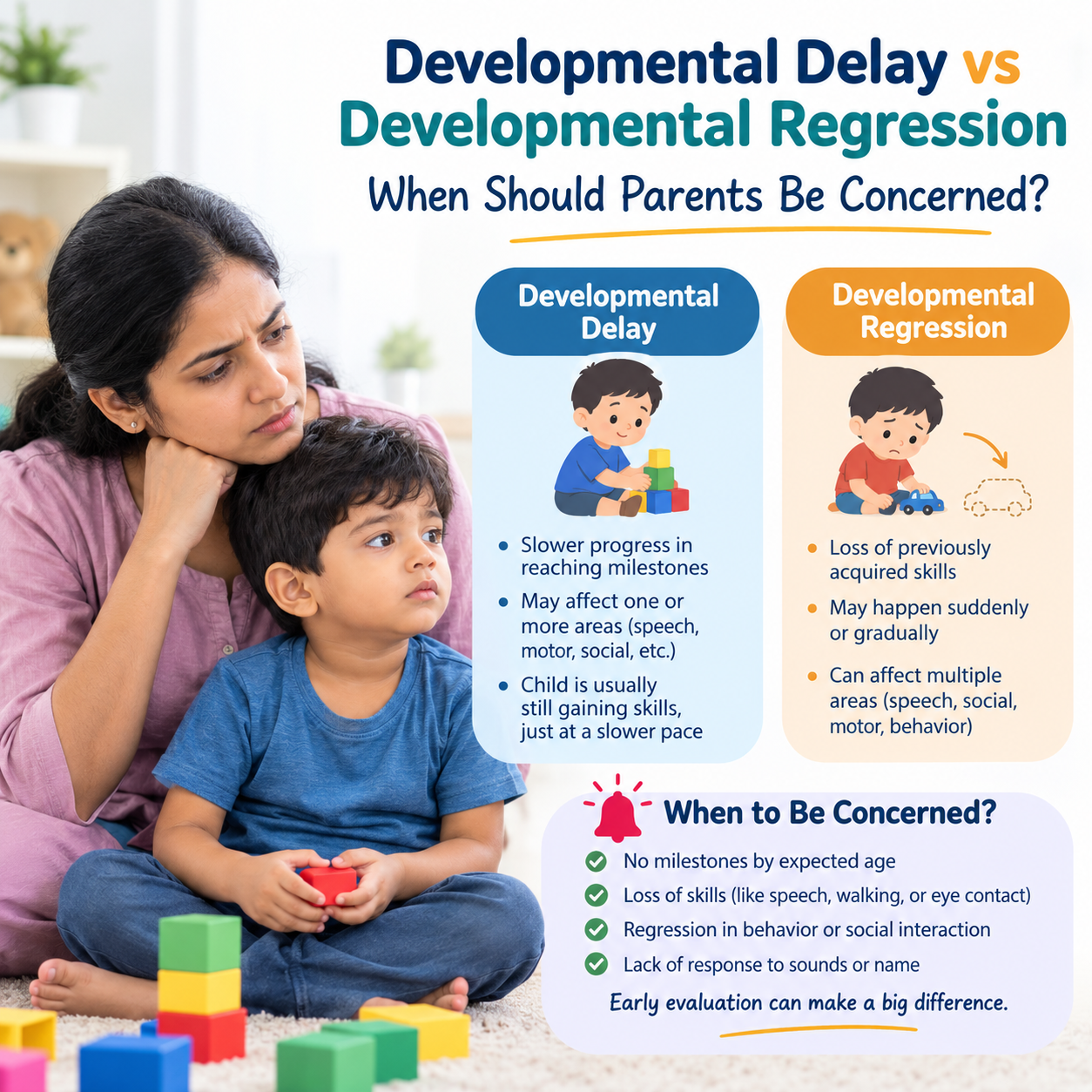
Most parents are familiar with the worry of a child who seems to be "behind" — not walking, talking, or sitting up when other children the same age already are. This is generally understood as developmental delay in children, and it's a common, often manageable part of pediatric care.
There is a different, less commonly discussed pattern that tends to cause much more concern when parents notice it: a child who had already learned a skill — walking, saying words, waving, making eye contact — and then appears to lose it. This is known as developmental regression, and it is evaluated differently from delay, because it can point toward a different set of underlying causes.
This article focuses specifically on the difference between these two patterns — delay versus regression — because understanding which one you're observing helps guide what kind of medical evaluation is appropriate. It does not diagnose any individual child, and it is not a substitute for a professional medical assessment.
What Is Developmental Delay?
Developmental delay describes a situation where a child has not yet reached a skill or milestone within the age range most children typically reach it. Importantly, the skill hasn't been lost — it simply hasn't appeared yet.
For example, a child who isn't yet combining two words by 24 months, when many children their age are, would generally be described as having a delay in expressive language. The skill is still ahead of them, not behind them.
Delay can occur in one developmental area or several, and has many possible contributing factors — from individual pace of development to hearing difficulties to prematurity. We've covered the causes, warning signs, and evaluation process for delay in detail in our related article on developmental delay in children(internal links), which is a useful starting point if delay — rather than loss of skills — is your primary concern.
What Is Developmental Regression?
Developmental regression refers to something different: a child loses skills or abilities they had already reliably demonstrated. This might include a child who used to say ten words and now says none, a child who could walk independently and now refuses or is unable to, or a child who made consistent eye contact and social engagement and has since withdrawn from it.
Regression is generally considered a more specific clinical signal than delay, because losing an already-acquired skill suggests that something may be actively affecting the nervous system or overall health, rather than simply a slower pace of typical development. This doesn't mean every instance of regression indicates a serious condition, but it does mean regression is treated as a more urgent reason for medical evaluation than delay alone.
Developmental Delay vs Regression – What Is the Difference?
The clearest way to distinguish the two is this:
In practice, this distinction matters because it changes the evaluation pathway. A child with an isolated speech delay and a child who has lost speech they previously had are usually assessed quite differently by a pediatrician, even though both situations understandably concern parents.
Why Can a Child Lose Previously Acquired Skills?
There are several reasons a child might lose a skill they'd previously shown, and not all of them point to a serious underlying disease:
Illness or hospitalization — a significant illness can temporarily affect a child's engagement or physical ability, with skills sometimes returning once the child recovers.
Sensory changes — a hearing or vision problem that develops after a skill was acquired can make it appear as though a related skill has been lost.
Significant environmental disruption — major stress, neglect, or disrupted routines can, in some cases, affect a young child's behavior and apparent skill level.
Neurological conditions — certain conditions affecting brain development or function can present with regression as an early or ongoing feature.
Metabolic or genetic conditions — some inherited conditions affect how the body processes certain substances, which over time can impact brain function and lead to skill loss.
Because the possible causes range from temporary and reversible to more serious and progressive, regression is not something to self-diagnose or wait out — it's a pattern best brought to a pediatrician's attention as soon as it's noticed.
Rare Conditions That May Be Associated With Developmental Regression
It's important to state clearly: most developmental regression is not caused by a rare genetic disorder, and regression can have non-genetic explanations as well. That said, according to resources from the National Organization for Rare Disorders (NORD) and the NIH's Genetic and Rare Diseases Information Center (GARD), a number of recognized rare conditions can present with regression as a feature, including:
Rett syndrome, a genetic neurodevelopmental condition that typically presents with a period of apparently typical development followed by loss of purposeful hand skills and language, predominantly in girls.
Certain leukodystrophies, such as metachromatic leukodystrophy, which affect the protective covering of nerve fibers and can lead to progressive loss of motor and cognitive function.
Niemann-Pick disease type C, a metabolic disorder that can affect the nervous system over time.
Sanfilippo syndrome (Mucopolysaccharidosis type III), a metabolic condition that can present with a period of typical early development followed by regression, particularly in language and behavior.
Certain mitochondrial disorders, which affect how cells produce energy and can impact multiple organ systems, including the brain.
Landau-Kleffner syndrome, a rare condition associated with loss of language skills, often linked to abnormal electrical activity in the brain.
This is not an exhaustive list, and mentioning these conditions is meant to illustrate that regression is a recognized feature of certain rare diseases — not to suggest that any child showing regression has one of them. A doctor considers many possibilities, and most are worked through systematically rather than assumed.
Warning Signs Parents Should Discuss With a Doctor
The following patterns are generally considered worth raising with a pediatrician promptly:
Loss of words or phrases the child previously used consistently
Loss of previously achieved motor skills, such as walking, crawling, or sitting
Reduced eye contact, social smiling, or engagement compared to before
New repetitive movements or behaviors that weren't present before
Loss of bladder or bowel control after it had been established
New or worsening seizures, or unusual episodes of staring or unresponsiveness
General loss of interest in previously enjoyed activities or interactions
Regression that continues or worsens over weeks rather than resolving
If you notice a pattern like this, it's reasonable — and appropriate — to seek a medical evaluation rather than waiting to see if the skills return on their own.
How Doctors Evaluate Developmental Regression
Evaluation of regression is typically more involved than evaluation of delay alone, and may include:
Detailed developmental history — understanding exactly which skills were present, when they were lost, and how quickly.
Physical and neurological examination — checking muscle tone, reflexes, growth patterns, and neurological signs.
Hearing and vision assessment — to rule out sensory causes contributing to the apparent regression.
Metabolic screening — blood or urine tests to check for metabolic conditions that can affect brain function.
Neuroimaging, such as an MRI, in some cases, to look for structural or degenerative changes in the brain.
EEG (electroencephalogram), particularly if seizures or unusual episodes are part of the picture.
Referral to a pediatric neurologist or geneticist, especially when initial findings suggest a neurological or genetic cause.
This process is designed to systematically rule causes in or out, rather than jumping to a single conclusion.
When Can Genetic Testing Be Considered?
Genetic testing for developmental regression is generally considered when the clinical evaluation suggests a possible underlying genetic or metabolic cause — for example, when regression is accompanied by other neurological findings, a specific pattern suggestive of a known genetic syndrome, or a family history of a similar condition.
Testing options may include targeted genetic tests for a specific suspected condition, metabolic panels, or broader testing such as chromosomal microarray or exome sequencing. As with any genetic evaluation, this is typically guided by a geneticist or genetic counselor, who can help interpret results in the context of your child's overall clinical picture, and discuss what a result — positive, negative, or uncertain — would mean going forward.
Why Early Medical Evaluation Matters
Regardless of the eventual cause, prompt evaluation of developmental regression offers real advantages:
It allows treatable causes — such as sensory issues, certain metabolic conditions, or seizure-related regression — to be identified and addressed sooner.
It supports early diagnosis of rare or progressive conditions, which can meaningfully affect how a family plans care, therapy, and support.
It reduces the period of uncertainty for families, replacing guesswork with a clearer clinical picture.
It connects families sooner to specialists and services suited to the specific condition, if one is identified, as part of coordinated rare disease care.
If you'd like a closer look at the specific signs that should prompt immediate medical attention, our upcoming article, Developmental Regression: Warning Signs Parents Should Never Ignore, goes into more detail on that topic specifically.
Frequently Asked Questions
1. Is developmental regression the same as developmental delay? No. Delay means a skill hasn't developed yet within the typical timeframe. Regression means a skill that was already present has been lost. They are evaluated differently because regression more often points to an underlying medical cause.
2. Can developmental regression be temporary? Yes, in some cases — for example, regression associated with illness, hospitalization, or significant environmental stress can improve once the underlying factor resolves. However, any regression should still be evaluated by a doctor rather than assumed to be temporary.
3. Does developmental regression always mean a genetic condition? No. Regression has multiple possible causes, including non-genetic ones. A genetic or metabolic cause is one possibility a doctor considers, based on the overall clinical picture, not an automatic conclusion.
4. At what age does developmental regression usually appear? Regression can appear at different ages depending on the underlying cause. Some conditions associated with regression, such as Rett syndrome, often become noticeable in the second year of life, but timing varies by condition and by child.
5. Should I wait to see if my child regains lost skills before seeing a doctor? No. Because regression can be linked to a range of causes, some of which benefit significantly from early identification, it's generally recommended to seek medical evaluation promptly rather than waiting.
6. What specialists are typically involved in evaluating regression? Depending on findings, a pediatrician may involve a pediatric neurologist, geneticist, developmental pediatrician, or metabolic specialist to help identify the underlying cause.
Medical Disclaimer
This article is intended for general informational purposes only and does not constitute medical advice, diagnosis, or treatment. It is not a substitute for professional evaluation by a qualified pediatrician, pediatric neurologist, geneticist, or other healthcare provider. If you notice your child losing previously acquired skills, please consult a licensed medical professional promptly for an individualized assessment.
References
Centers for Disease Control and Prevention (CDC) – Developmental Milestones & “Learn the Signs. Act Early.” CDC Developmental Milestones
American Academy of Pediatrics (AAP) – Developmental Surveillance and Screening. AAP Developmental Surveillance and Screening
National Institutes of Health (NIH) – Genetic and Rare Diseases Information Center (GARD) – Rare disease information and resources.
National Organization for Rare Disorders (NORD) – Rare Disease Database.
International Rett Syndrome Foundation – Information and resources on Rett syndrome and developmental regression
Centers for Disease Control and Prevention (CDC) – Developmental Milestones & “Learn the Signs. Act Early.” CDC Developmental Milestones
American Academy of Pediatrics (AAP) – Developmental Surveillance and Screening. AAP Developmental Surveillance and Screening
National Institutes of Health (NIH) – Genetic and Rare Diseases Information Center (GARD) – Rare disease information and resources.
National Organization for Rare Disorders (NORD) – Rare Disease Database.
International Rett Syndrome Foundation – Information and resources on Rett syndrome and developmental regression
