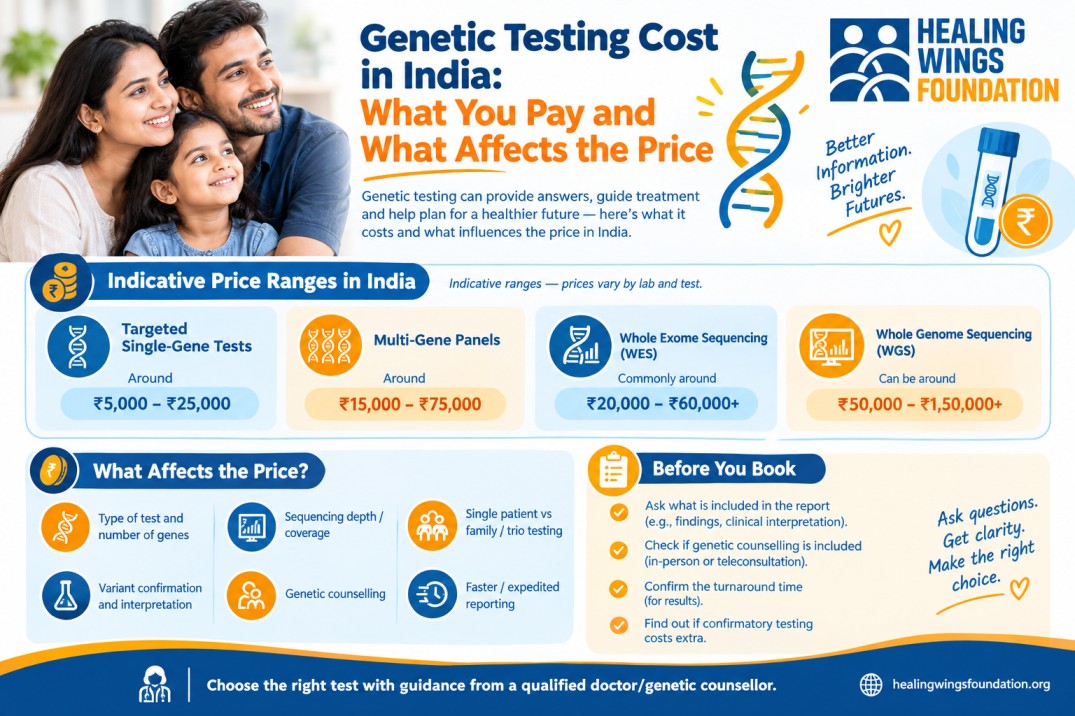
When a doctor suggests genetic testing, the medical questions come with a practical one: how much will this cost? In India, prices vary widely, from a few thousand rupees for a single-gene test to well over a lakh for broad genome sequencing. Knowing what drives the price helps you ask the right questions and avoid paying for the wrong test.
If you’re still deciding whether testing is right for your child, start with our guide on when to consider genetic testing.
Typical price ranges in India
These are indicative ranges only. Actual prices depend on the lab, city, and what is included, so always ask for a written quote.
Some labs also offer combined packages, such as exome sequencing with microarray, and “focused” or “clinical” exome tests that cost less than a full exome.
What affects the price
Type of test. The more genes a test reads, the more it usually costs.
Trio testing. Testing the child and both parents together makes the result easier to interpret, but you pay for three samples.
The lab. Large reference labs, hospital genetics departments, and smaller specialised labs price differently.
Turnaround time. Faster or urgent reporting often costs extra, which matters in critically ill infants.
Reporting depth. Some quotes include only the report, while others include doctor review of results and re-analysis later.
Counselling. Pre-test and post-test genetic counselling may or may not be included.
Confirmation testing. A finding sometimes needs to be confirmed in parents or relatives, which adds cost.
Sample collection and shipping. Home collection or sending samples to another city can add charges.
Questions to ask before you pay
Which test is being recommended, and why this one rather than a cheaper option?
Exactly what is included: sample collection, report, counselling, parent testing?
How long will results take?
What happens if the result is negative or unclear? Is re-analysis offered later, and at what cost?
Is the lab accredited, and who will explain the results to us?
A cheaper test is not always better value. A narrow test that misses the answer can end up costing more than the right test done first. Our genetic testing guide for patients and families explains how to choose between the options.
Will insurance cover it?
Coverage in India is inconsistent. Many health insurance policies exclude genetic testing or cover it only when it is part of an inpatient admission. Before testing, ask your insurer in writing whether the specific test is covered, and what documents (doctor’s note, clinical summary) they need. Keep all bills and reports for claims.
Ways to reduce the cost
Ask your doctor for a stepwise plan. Sometimes a targeted test or microarray is the sensible first step, with exome sequencing reserved for later if needed.
Compare written quotes from two or three accredited labs.
Check government and institutional support. India’s National Policy for Rare Diseases has designated Centres of Excellence and diagnostic centres, and some government hospitals and medical colleges offer testing at lower cost. Eligibility and availability change, so confirm current details with the centre.
Look into research and subsidised programmes. Some hospitals and research projects offer testing at reduced or no cost for eligible families.
Reach out for guidance. Our team and resources on patient advocacy support can help you understand your options.
Why timing matters
Delaying testing because of cost can also carry a price, in lost time for treatment and support. An early answer can guide therapy, avoid unnecessary tests, and help you plan. Read more on why early diagnosis matters for families facing rare conditions.
Next steps
Ask your child’s doctor which test is most likely to give an answer first.
Request a genetics referral or genetic counselling session.
Get itemised written quotes before booking.
Check your insurance policy and keep all paperwork.
Contact us if you need help finding the right support.
This article is for general education and isn’t a substitute for medical advice. Prices are approximate and change over time. Please confirm costs with the lab or hospital and discuss testing with your child’s healthcare team.
References
Narayanan DL, Girisha KM. Genomic testing for diagnosis of genetic disorders in children: chromosomal microarray and next-generation sequencing. Indian Pediatrics. 2020;57(6):549-554. doi:10.1007/s13312-020-1853-3
Genomic diagnosis for pediatric disorders: revolution and evolution. Frontiers in Pediatrics. 2020;8:373. doi:10.3389/fped.2020.00373
Clinical utility of proband-only clinical exome sequencing in neurodevelopmental disorders. Indian Journal of Pediatrics. 2023. PMID 37943464
Ministry of Health and Family Welfare, Government of India. National Policy for Rare Diseases, 2021. Details of the policy (press release, 9 August 2024)
Ministry of Health and Family Welfare. Reply on the National Fund for Rare Diseases, Parliament of India (Lok Sabha). eparlib.sansad.in
