For families navigating unexplained symptoms, developmental concerns, or a puzzling set of medical findings, one of the most common questions is: "How long will it take to get an answer?" For rare diseases, that question often doesn't have a simple answer. Many rare conditions take months or years to diagnose, and the path there can involve multiple specialists, tests, and, understandably, a great deal of uncertainty for the family.
This article looks at why early diagnosis of rare diseases is generally considered valuable, what the diagnostic process typically involves, and what tends to happen once a diagnosis is reached. It's written for patients, parents, and caregivers who may be somewhere along this journey — whether just starting to ask questions or already working through a formal evaluation. It does not diagnose any individual's condition, and it does not claim that early diagnosis guarantees a particular outcome; what it aims to do is explain, in plain terms, why timing can matter and what it may make possible.
What Is a Rare Disease Diagnostic Journey?
The term "diagnostic journey" is often used to describe the sometimes long and winding path patients and families take from first noticing symptoms to arriving at a confirmed diagnosis. For rare diseases, this journey can look quite different from diagnosing a common condition:
Symptoms may be vague, overlapping with more common conditions, or appear gradually over time.
A single specialist may not have enough information to reach a diagnosis alone, requiring input from multiple fields.
Some rare conditions have overlapping features with each other, making it necessary to rule several possibilities in or out systematically.
Testing for very rare conditions may not be part of standard first-line evaluation and may only be considered after more common explanations have been excluded.
Research summarized by organizations such as the National Organization for Rare Disorders (NORD) and EURORDIS (Rare Diseases Europe) has documented that many rare disease patients see multiple doctors and experience delays of several years before receiving a confirmed diagnosis. This isn't necessarily a reflection of anyone doing something wrong — it reflects how genuinely difficult many rare conditions are to identify.
Why Can Rare Diseases Take Time to Diagnose?
Several factors commonly contribute to delayed diagnosis in rare diseases:
Rarity itself — by definition, individual clinicians may see a given rare condition only a handful of times, or never, across an entire career, making pattern recognition harder.
Symptom overlap — many rare diseases share symptoms with more common conditions, meaning more common explanations are often (reasonably) considered and ruled out first.
Variable presentation — the same rare disease can look quite different from one patient to another, even within the same family in some genetic conditions.
Limited awareness — general awareness of specific rare conditions can be lower among non-specialist healthcare providers, simply due to how infrequently they're encountered.
Access to specialized testing — some diagnostic tests, particularly certain genetic or metabolic tests, may only be available through specialist centers or on referral.
Understanding these factors doesn't shorten the diagnostic journey by itself, but it can help families make sense of why a diagnosis is taking time, and support more constructive conversations with their healthcare team about next steps.
Why Early Diagnosis Can Matter
It's important to be precise here: early diagnosis does not guarantee a better outcome in every rare disease, and the value of early diagnosis varies considerably depending on the specific condition. That said, in many circumstances, an earlier diagnosis may help in several practical ways:
Earlier access to appropriate management — for some conditions, treatments or interventions are most effective when started before certain changes become established, so earlier diagnosis can support better-timed care.
Reduced diagnostic burden — an earlier answer can mean fewer repeated tests, appointments, and unresolved uncertainty for the patient and family.
Better-informed family planning — for genetic conditions, an earlier diagnosis can help families understand recurrence risk and make informed decisions with genetic counseling support.
Access to condition-specific resources — a confirmed diagnosis often opens the door to patient organizations, specialist clinics, and support networks tailored to that specific condition.
Clearer expectations — even when a condition doesn't have a specific treatment, understanding what it is can help families plan care, therapy, and support more proactively rather than reactively.
Because treatment and management approaches vary enormously between rare diseases — some have targeted therapies, some are managed primarily through supportive and symptomatic care, and some currently have no specific treatment at all — what early diagnosis "changes" depends heavily on the individual condition. A specialist familiar with a specific diagnosis is best placed to explain what timing may mean in that particular case.
How Doctors Investigate Suspected Rare Diseases
When a rare disease is suspected, the evaluation process is typically structured and incremental:
Detailed history-taking, covering symptom onset, progression, and family medical history across generations where relevant.
Physical examination, looking for specific clinical signs, growth patterns, or physical features that might point toward a particular condition or category of conditions.
Standard laboratory and imaging tests, used first to rule out more common explanations.
Specialist referral, often to fields such as genetics, neurology, metabolic medicine, immunology, or others depending on the presenting features.
Targeted or broader testing, including specific biochemical tests or genetic analysis, once the clinical picture narrows the possibilities.
Multidisciplinary review, particularly in complex cases, where specialists from different fields compare findings to reach a working diagnosis.
This is often not a single appointment but an ongoing process, sometimes over months, particularly for conditions without a single confirmatory test.
The Role of Genetic Testing
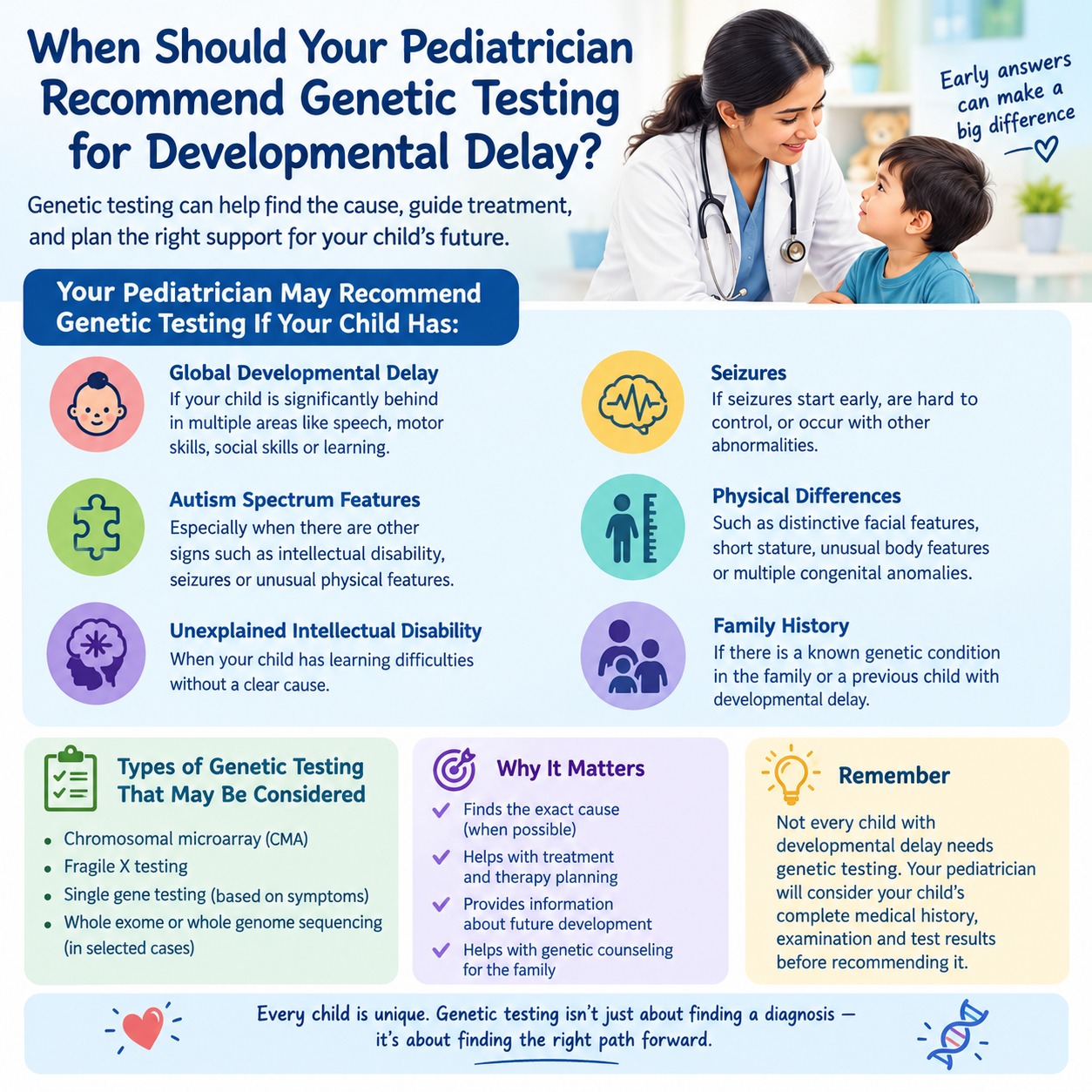
Rare disease genetic testing has become an increasingly important part of the diagnostic process, particularly as testing technology has advanced and become more accessible. Genetic testing may be considered when:
A condition's clinical features suggest a likely genetic or chromosomal basis.
There is a family history suggestive of an inherited condition.
Standard evaluations haven't identified a clear cause, and a genetic basis remains a reasonable next step.
Testing approaches vary depending on the clinical suspicion — from single-gene tests aimed at a specific suspected condition, to broader approaches such as gene panels, chromosomal microarray analysis, or exome/genome sequencing that examine many genes at once. Genetic counselors and clinical geneticists play an important role here, both in selecting the most appropriate test and in helping families understand the results — including situations where a result is inconclusive or identifies a variant of uncertain significance, which can happen even with modern testing.
For families specifically navigating developmental delay in a child, our related articles on developmental delay in children and genetic testing for developmental delay go into more detail on when genetic evaluation is typically considered in that context.
What Can Happen After a Diagnosis?
Once a rare disease diagnosis is confirmed, the next steps depend heavily on the specific condition, but commonly include:
A management plan, which may involve medication, dietary changes, therapy, monitoring, or a combination of approaches depending on the condition.
Referral to condition-specific specialists, particularly for conditions affecting multiple organ systems, where coordinated care across several fields is often needed.
Genetic counseling, especially for inherited conditions, to discuss implications for the patient and other family members.
Ongoing monitoring, since many rare diseases require regular follow-up to track progression or response to management over time.
Connection to patient communities, which can offer practical guidance and emotional support from others managing the same or similar conditions.
It's worth reiterating that not every rare disease currently has a specific treatment. In some cases, the value of diagnosis lies mainly in enabling appropriate symptomatic care, informed family planning, and access to support — which are still meaningful outcomes, even without a cure.
Access to Specialist Care and Patient Support
Coordinated, condition-aware care tends to make a meaningful difference in day-to-day quality of life for patients with rare diseases, even when the underlying condition itself can't be changed. This is one of the reasons specialized rare disease care pathways exist — to bring together the right combination of specialists, therapies, and monitoring suited to a specific diagnosis, rather than leaving families to coordinate this on their own.
Beyond clinical care, many families find real value in connecting with organized rare disease resources — including patient advocacy groups, condition-specific foundations, and structured educational materials — which can help translate a diagnosis into practical, day-to-day guidance.
Questions Patients and Families Can Ask Their Healthcare Team
If you're in the middle of a diagnostic process, or have just received a diagnosis, these questions can help guide productive conversations with your care team:
What tests have been done so far, and what are we still trying to rule in or out?
Are there specialists we should be seeing that we haven't yet?
If a diagnosis is confirmed, what would the immediate next steps look like?
Are there condition-specific patient organizations or resources you'd recommend?
If genetic testing is being considered, what would a positive, negative, or inconclusive result mean for us?
Who should we contact between appointments if we have new concerns?
Bringing a written list of questions to appointments can help make the most of limited appointment time, especially when navigating a complex or uncertain diagnostic process.
Frequently Asked Questions
1. Does early diagnosis guarantee a better outcome in rare diseases? No. The impact of early diagnosis varies considerably between conditions. In some rare diseases, earlier diagnosis can support better-timed treatment or management; in others, particularly those without a specific treatment, the main benefit may be clearer information and earlier access to supportive care and resources.
2. Why do some rare diseases take years to diagnose? Common reasons include overlapping symptoms with more common conditions, variability in how the same condition presents between patients, and the fact that individual clinicians may rarely encounter a specific rare disease, making recognition more difficult.
3. Is genetic testing always part of diagnosing a rare disease? Not always. Genetic testing is one tool among several and is generally used when clinical findings suggest a likely genetic cause. Some rare diseases are diagnosed through other means, such as specific biochemical tests or characteristic clinical findings.
4. What should I do if I feel my or my child's symptoms aren't being taken seriously? It's reasonable to ask for a second opinion or referral to a specialist, particularly if symptoms are persistent, worsening, or not explained by initial evaluations. Bringing a detailed, written symptom history can also help support your case during appointments.
5. Can a rare disease diagnosis change even after some testing has already been done? Yes, in some cases. Diagnostic understanding can evolve as new symptoms appear, as more advanced tests become available, or as specialists review the case further. A working diagnosis is sometimes revised as more information becomes available.
6. Where can families go for support after a rare disease diagnosis? Many families benefit from condition-specific patient organizations, genetic counseling services, and specialist rare disease clinics, in addition to their primary care team. These can provide both practical guidance and connection with others facing similar circumstances.
Medical Disclaimer
This article is intended for general informational purposes only and does not constitute medical advice, diagnosis, or treatment. It is not a substitute for professional evaluation by a qualified physician, clinical geneticist, or other healthcare provider. If you or a family member have symptoms of concern or are navigating a suspected rare disease, please consult a licensed medical professional for individualized guidance.
References
National Organization for Rare Disorders (NORD) — Rare Disease Diagnostic Journey resources.
EURORDIS – Rare Diseases Europe — Survey data on diagnostic delay in rare diseases.
National Institutes of Health, Genetic and Rare Diseases Information Center (GARD).
American College of Medical Genetics and Genomics (ACMG) — Clinical guidance on genetic testing and counseling.
World Health Organization (WHO) — Rare Diseases resources.
