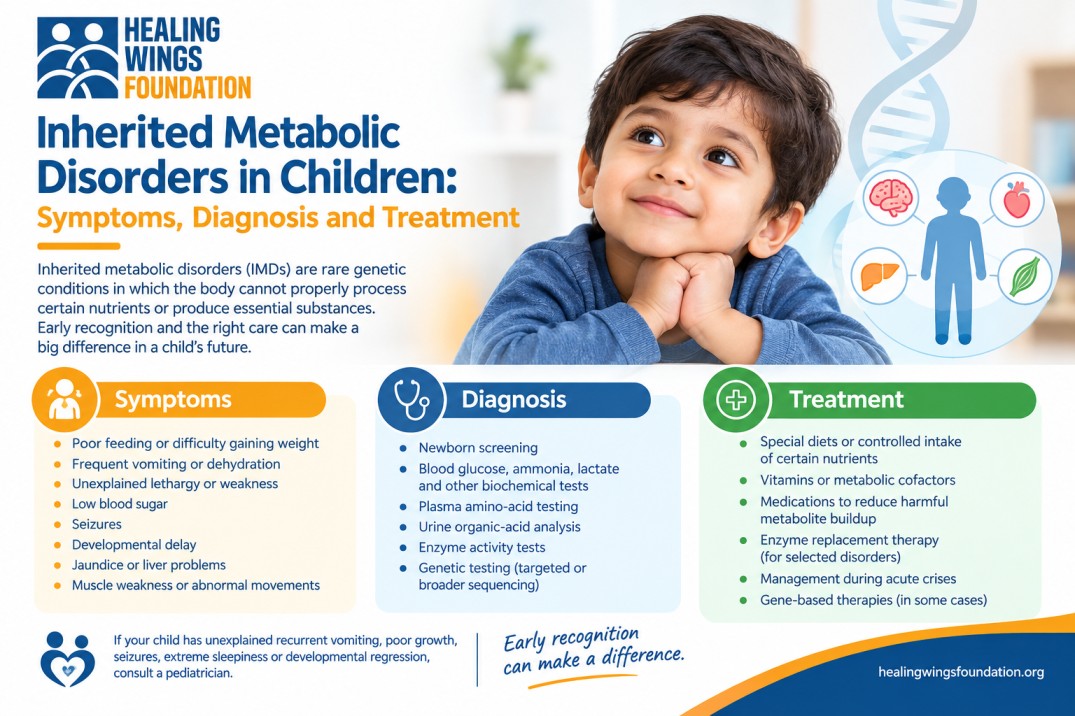
Most babies who are born with an inherited metabolic disorder look completely healthy at birth. The trouble often starts days, weeks or even years later, with symptoms as ordinary as poor feeding or repeated vomiting. Because these signs look like common childhood illnesses, the real cause is often missed, and valuable time is lost.
This guide explains what inherited metabolic disorders are, the symptoms parents should not ignore, how they are diagnosed, what treatment looks like, and what support exists in India.
What are inherited metabolic disorders?
Inherited metabolic disorders, also called inborn errors of metabolism, are genetic conditions in which the body cannot properly break down, make or move certain substances. In most of them, a single gene change affects an enzyme, which is a protein that carries out one step in a chemical pathway. When the step is blocked, harmful substances can build up, or the body cannot make something it needs for energy.
There are hundreds of these disorders. Each one is rare, but together they make up a significant group. Most are passed on when both parents carry a change in the same gene, often without knowing it. Some are X-linked or come from changes in mitochondrial DNA, which passes down through the mother.
The main groups
Doctors often sort these disorders by what goes wrong:
Disorders where toxic substances build up: These include amino acid disorders such as phenylketonuria (PKU) and maple syrup urine disease, organic acidemias such as methylmalonic and propionic acidemia, and urea cycle disorders, where ammonia builds up in the blood.
Energy metabolism disorders: The body cannot produce or release enough energy. Examples include fatty acid oxidation disorders, glycogen storage disorders and mitochondrial disorders.
Disorders of large molecules: Material builds up inside the cell’s compartments. Lysosomal storage disorders, such as Pompe disease and mucopolysaccharidoses, and peroxisomal disorders belong here.
Symptoms: when to suspect a metabolic disorder
Metabolic disorders can appear at two stages of life. A complete block in a pathway causes problems in the newborn period, and a partial block can show up months or years later, often when the child is under stress from illness or fasting.
In newborns and young infants:
A baby who is well at first, then feeds poorly, vomits and becomes unusually sleepy
Fast or laboured breathing
Low body temperature, floppiness or poor tone
Seizures, or difficulty waking the baby
Jaundice or an enlarged liver
A strange body or urine smell (uncommon, but helpful)
In older infants and children:
Repeated vomiting and dehydration, especially with fever or fasting
Poor weight gain
Developmental delay, or loss of skills the child had already learned
Low muscle tone, weakness or unsteady walking
Seizures, or episodes of confusion or coma
Low blood sugar that keeps coming back
Red flags that should raise suspicion:
Symptoms that get much worse during an ordinary illness
Repeated vomiting that does not improve even after changing the feed or formula
Symptoms after starting a new food, or after a long gap between meals
A sibling or relative with a similar illness, or an unexplained death of a baby in the family
Parents who are blood relatives
Because newborn metabolic crises can look like a serious infection, doctors often test for both at the same time. Many of these conditions also appear on our list of rare diseases that cause developmental delay.
Metabolic crisis: a medical emergency
A metabolic crisis happens when harmful substances build up quickly or the body runs out of energy. It is often triggered by infection, fever, vomiting, diarrhoea or going without food for too long. Signs include:
Repeated vomiting and refusing feeds
Extreme sleepiness, irritability or confusion
Fast breathing
Seizures or loss of consciousness
If you see these signs, take your child to a hospital immediately, and ideally to a children’s hospital with a metabolic or genetics team. Do not wait for the symptoms to pass. Tell the doctors that a metabolic disorder is possible. If your child already has a diagnosis, follow your “sick day” or emergency plan and carry your emergency letter with you.
How are metabolic disorders diagnosed?
Diagnosis is done in steps, and a metabolic specialist usually helps interpret the results:
First-line blood and urine tests: These include blood sugar, ammonia, lactate, blood acid levels and ketones. Samples taken during an illness or crisis are especially valuable, as results can look normal once the child recovers.
Specialised biochemical tests: Plasma amino acids, urine organic acids and an acylcarnitine profile show the pattern of chemicals in the body and help point to the group of disorders.
Enzyme tests: Measuring the activity of a specific enzyme in blood cells or skin cells can confirm many conditions. This is the standard route for most lysosomal storage disorders.
Genetic testing: Finds the exact gene change, confirms the diagnosis and shows the risk for other family members.
A precise diagnosis matters for more than treatment. It guides genetic counselling and allows testing in future pregnancies. Our early diagnosis programme supports families through this process.
Newborn screening in India
In many countries, a few drops of blood from a newborn’s heel are tested for metabolic disorders so that treatment can begin before symptoms appear. In India, there is no universal national programme for expanded screening of metabolic disorders yet. Some hospitals and private laboratories offer expanded screening using tandem mass spectrometry, and several treatable conditions can be missed when screening is not done.
If your baby is born in a hospital that offers expanded newborn screening, ask for it. A screening result is not a diagnosis. A positive screen must be confirmed with enzyme tests, biochemical analysis or genetic testing. If you have a family history of a metabolic disorder, speak to a doctor before or early in pregnancy about testing options.
How are inherited metabolic disorders treated?
The right treatment depends on the exact disorder, and many conditions can be treated well when found early. Treatment is best delivered by a team of a metabolic specialist, paediatrician, dietitian and others. Approaches include:
Special diets: Limiting the food component that the body cannot handle. In PKU, a low-protein diet with a special phenylalanine-free protein supplement is the mainstay. In galactosaemia, galactose is removed from the diet.
Vitamins and cofactors: Some enzymes work better when given extra amounts of their helper molecules, such as certain vitamins.
Medicines that remove harmful substances: Used to lower ammonia or other toxic chemicals.
Enzyme replacement therapy: A regular infusion of the missing enzyme, used in several lysosomal storage disorders, including Pompe disease and some mucopolysaccharidoses.
Substrate reduction therapy: Medicines that reduce the build-up of the substance the body cannot clear.
Liver transplantation: For selected conditions, such as some urea cycle disorders and tyrosinaemia, a transplant can supply the missing enzyme. Some children may still need dietary care.
Gene therapy: An emerging approach that has shown benefit in some disorders and is being studied for others.
Emergency “sick day” plans: Written instructions for what to do during fever, vomiting or poor feeding, to prevent a crisis.
Not every disorder has a specific treatment yet. In some, such as many mitochondrial respiratory chain disorders, care mainly focuses on supporting the child. Many effective treatments are “orphan drugs,” made for very small patient groups, which can make them hard to access. Read more in our article on orphan drugs for rare disease patients.
Support and funding in India
Under India’s National Policy for Rare Diseases, 2021, designated Centres of Excellence offer diagnosis and treatment for listed rare diseases, including several metabolic conditions such as lysosomal storage disorders, some glycogen storage disorders and urea cycle disorders. The policy provides for financial support for treatment at these centres. The list of covered diseases, categories and the amount of support can change, so please check the current rules with a Centre of Excellence or the Ministry of Health website.
Families do not have to work through this alone. Our rare disease care programme helps families find the right specialists and understand their options.
What to do right now if you suspect a metabolic disorder
If your child is unwell with repeated vomiting, unusual sleepiness, fast breathing or seizures, go to a hospital immediately.
Write down when symptoms began, what triggered them (illness, fasting, new food) and how often they happen.
Ask your paediatrician for a referral to a metabolic specialist or paediatric geneticist.
Collect all reports and note any family history, including deaths of babies and marriages between relatives.
Do not stop or change prescribed diets or medicines without your doctor’s advice.
Frequently Asked Questions
1. What is an inherited metabolic disorder?
It is a genetic condition in which the body cannot properly break down, make or move certain substances, usually because an enzyme is missing or not working. This can cause harmful build-up or an energy shortage.
2. What are the first signs of a metabolic disorder in a baby?
Poor feeding, repeated vomiting, unusual sleepiness, fast breathing, floppiness and seizures are common early signs. Many babies look healthy at birth and become unwell within days or weeks.
3. Can a metabolic disorder appear later in childhood?
Yes. A partial enzyme problem may show up months or years later, often during an illness, fasting or after starting a new food. Developmental delay or repeated episodes of vomiting and confusion can be the first sign.
4. What tests diagnose a metabolic disorder?
Doctors start with blood tests such as sugar, ammonia and lactate, then use special tests for amino acids, organic acids and acylcarnitines. Enzyme tests and genetic testing confirm the diagnosis.
5. Is there newborn screening for metabolic disorders in India?
Expanded newborn screening is offered by some hospitals and private laboratories, but there is no universal national programme yet. Ask your hospital whether it is available, and remember that a positive screen needs confirmation.
6. Can inherited metabolic disorders be treated?
Many can be managed well, especially when found early. Treatment may include special diets, vitamins, medicines, enzyme replacement therapy or liver transplantation, depending on the disorder. Some conditions have no specific treatment yet, and care focuses on support.
7. What is a metabolic crisis?
It is a sudden worsening in which harmful substances build up or the body runs short of energy, often triggered by infection, vomiting or fasting. It is an emergency and needs immediate hospital care.
8. Are metabolic disorders hereditary?
Yes. Most are inherited when both parents carry a change in the same gene, even though they are healthy. Some are X-linked, or pass through the mother’s mitochondrial DNA. A genetic counsellor can explain the chance in your family.
9. Will my other children be affected?
It depends on the condition and how it is inherited. Testing and genetic counselling can tell you the chance for other children and for future pregnancies, and may allow testing during pregnancy.
10. Where can families get help in India?
Metabolic and genetics departments at large paediatric hospitals, and the Centres of Excellence under the National Policy for Rare Diseases, can help with diagnosis and treatment. Healing Wings Foundation works with families on exactly this, and you can contact our team for guidance.
References
University of Hawaii John A. Burns School of Medicine: Pediatric Textbook, Chapter IV.9, Inborn errors of metabolism.
Orphanet Journal of Rare Diseases, 2025: Inherited metabolic disorders: presentation, clinical types, laboratory diagnosis and genetic markers.
Johns Hopkins Medicine: Inherited metabolic disorders.
emDocs: Inborn errors of metabolism: pearls and pitfalls.
WikEM: Inborn error of metabolism (emergency evaluation and management).
Indian Journal of Practical Pediatrics, 2010: Special issue on inborn errors of metabolism, including newborn screening and its relevance in India.
Movement Disorders Clinical Practice, 2021: Suggested screening for inborn errors of metabolism according to clinical suspicion.
Indian Journal of Practical Pediatrics, 2025: Laboratory workup in suspected inborn errors of metabolism, a stepwise approach.
Newborn WHO Collaborating Centre: Inborn errors of metabolism, 2019.
Indian Journal of Child Health, 2019: A preliminary report on newborn screening of inborn metabolic disorders.
PubMed Central, 2020: Review of newborn screening for inborn errors of metabolism and the barriers to universal screening in India.
Jornal de Pediatria, 2009: Treatment of inborn errors of metabolism.
Journal of Inherited Metabolic Disease, 2006: Clinical approach to treatable inborn metabolic diseases, an introduction.
Pediatric Transplantation: Liver transplantation for inborn errors of metabolism.
Nutrients (MDPI): Special issue, Advances in inherited metabolic disorders.
Ministry of Health and Family Welfare, Government of India: National Policy for Rare Diseases, 2021.
Parliament of India (Lok Sabha reply): Support to patients of rare diseases.
Disclaimer: This article is for general awareness and does not replace advice from a qualified doctor. If your child has repeated vomiting, extreme sleepiness, fast breathing, seizures or looks unwell, please seek emergency medical care immediately.
