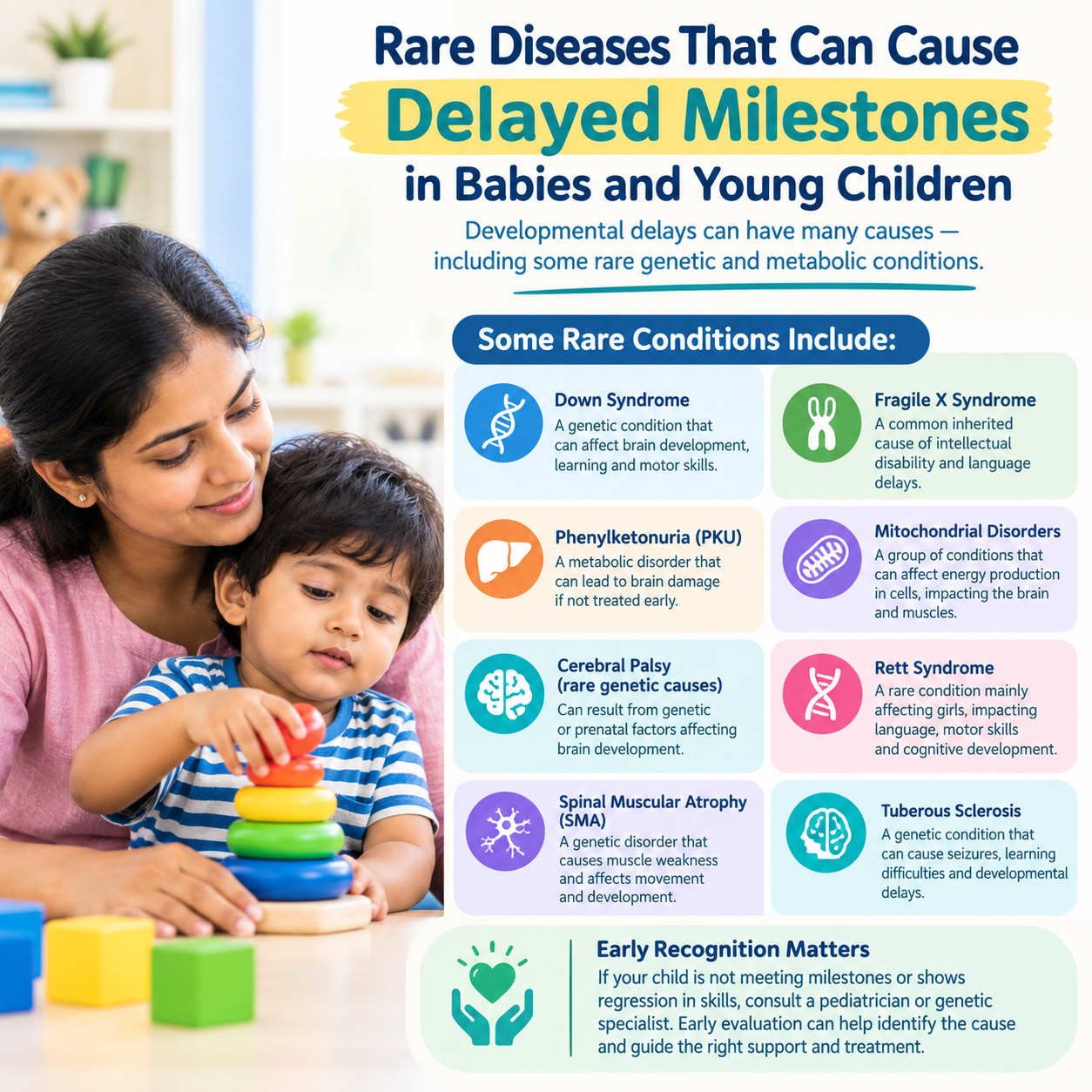
If your baby or young child is taking longer than expected to sit, walk, talk, or interact socially, it's natural to search for answers — and it's easy for that search to lead to frightening possibilities. It's important to start with an honest, reassuring fact: most developmental delay is not caused by a rare disease. The great majority of children with delayed milestones have common, often temporary or manageable explanations.
At the same time, a smaller number of children with developmental delay do have an underlying rare genetic, metabolic, or neurological condition. Understanding which categories of rare diseases can be associated with developmental delay — and why — can help parents have more informed conversations with their pediatrician, without assuming the worst. This article provides a general, educational overview of these categories. It is not intended to diagnose any individual child or suggest that delay automatically points to one of these conditions.
Understanding Developmental Delay
Developmental delay means a child has not yet reached an expected skill — in motor ability, speech and language, cognition, or social-emotional development — within the typical age range for that skill. It's an observation, not a diagnosis, and it has a wide range of possible explanations, from individual variation in pace, to prematurity, to sensory issues like hearing loss.
We've covered the broader picture of what delay is, common non-genetic causes, and general warning signs in our article on developmental delay in children. It's also worth understanding that delay is different from a child losing skills they'd already gained, a pattern known as developmental regression, which is generally evaluated with more urgency. This article focuses specifically on one part of the picture: the rare disease categories that are sometimes associated with delay, for parents who want to understand that possibility more clearly.
Why Can Rare Diseases Affect Development?
Development depends on multiple body systems working together — the brain and nervous system, muscles, sensory organs, and the body's underlying metabolic processes. Rare diseases can affect development when they interfere with:
Brain structure or function, affecting how the brain processes information, controls movement, or supports learning.
Muscle tone and strength, affecting motor milestones such as sitting, crawling, or walking.
Metabolic processes, where the body's inability to break down or process certain substances can, over time, affect brain and organ function.
Sensory processing, such as hearing or vision, which are foundational to language and social development.
Because these conditions are individually uncommon — often affecting a small number of children per thousand or per million births — they are collectively referred to as "rare diseases," even though as a group, rare diseases affect a meaningful number of children worldwide.
Categories of Rare Diseases Associated With Developmental Delay
Broadly, the rare conditions linked to developmental delay tend to fall into three overlapping categories, which the following sections describe in more detail:
Genetic disorders — caused by changes in genes or chromosomes.
Inherited metabolic disorders — caused by the body's inability to process certain nutrients or substances correctly.
Neurological and neuromuscular conditions — affecting the brain, spinal cord, or muscles.
Many rare diseases don't fit neatly into just one category — a genetic condition, for example, can also be classified as a metabolic disorder if the underlying gene affects a metabolic pathway. These categories are meant to help parents understand the general landscape, not to serve as a checklist for self-assessment.
Genetic Disorders and Developmental Delay
Genetic disorders result from changes in a person's genes or chromosomes, and some are associated with developmental delay as a common feature. According to resources from the National Organization for Rare Disorders (NORD) and the NIH's Genetic and Rare Diseases Information Center (GARD), examples include:
Down syndrome (Trisomy 21) — one of the more well-known chromosomal conditions, commonly associated with developmental delay, alongside characteristic physical features and, in many cases, congenital heart conditions.
Fragile X syndrome — a genetic condition and one of the more common inherited causes of intellectual disability, often presenting with delayed speech and language, along with certain behavioral features.
Angelman syndrome — a genetic condition associated with significant developmental delay, limited speech, and characteristic movement and behavioral patterns.
Williams syndrome — a genetic condition associated with developmental delay alongside a distinctive personality profile and, often, cardiovascular differences.
These are examples, not an exhaustive list, and each has a different pattern of features beyond developmental delay alone. A genetic diagnosis is made through clinical evaluation and testing, not from developmental delay in isolation.
Inherited Metabolic Disorders and Development
Inherited metabolic disorders occur when the body lacks an enzyme or process needed to break down certain substances — proteins, fats, or carbohydrates — correctly. Left unaddressed, the buildup of these substances, or the resulting deficiency of something the body needs, can affect brain development and function over time. Examples recognized by GARD and NORD include:
Phenylketonuria (PKU) — a condition affecting the body's ability to process an amino acid called phenylalanine; if unmanaged, it can affect cognitive development, which is why many countries include it in routine newborn screening.
Mucopolysaccharidoses (MPS), such as Hurler syndrome and Sanfilippo syndrome — conditions in which the body cannot properly break down certain complex sugars, which can accumulate over time and affect multiple organ systems including the brain.
Mitochondrial disorders — conditions affecting how cells produce energy, which can impact organs with high energy demands, including the brain and muscles, leading to developmental difficulties.
Urea cycle disorders — conditions affecting the body's ability to remove ammonia, a waste product, which can affect neurological function if not managed.
Many inherited metabolic disorders are now part of expanded newborn screening programs in various countries, which is one reason early detection has improved for some of these conditions over recent decades.
Neurological and Neuromuscular Conditions
Some rare conditions primarily affect the brain, spinal cord, or muscles directly, which can present as developmental delay, particularly in motor skills:
Spinal muscular atrophy (SMA) — a genetic condition affecting the nerve cells that control muscle movement, which can lead to progressive muscle weakness and delayed motor milestones.
Congenital muscular dystrophies — a group of genetic conditions affecting muscle strength and tone from early infancy, often presenting with delayed motor development.
Tuberous sclerosis complex — a genetic condition that can cause benign growths in multiple organs, including the brain, and is associated with developmental delay in some, though not all, affected children.
Certain structural brain differences, present from birth or arising during early development, which can affect motor, cognitive, or speech milestones depending on the areas of the brain involved.
As with the other categories, developmental delay is one possible feature among several, and the overall clinical picture — not delay alone — guides diagnosis.
When Should Parents Seek Medical Evaluation?
Regardless of the underlying cause, certain patterns are generally worth discussing with a pediatrician:
Delay affecting more than one developmental area (for example, both motor skills and language)
Delay accompanied by unusual muscle tone, either floppy or stiff
Distinctive physical features noted by a doctor
A family history of a genetic condition, intellectual disability, or unexplained developmental delay
Loss of previously acquired skills (developmental regression) at any point
Delay that does not improve, or worsens, despite general support and time
Raising these observations with a pediatrician allows for a structured evaluation, rather than parents trying to interpret patterns on their own.
How Doctors Investigate the Underlying Cause
When a rare underlying cause is suspected, evaluation is typically stepwise and may include:
Detailed developmental and family history, including how and when delays were first noticed.
Physical examination, looking for growth patterns, muscle tone, reflexes, and any distinctive physical features.
Hearing and vision screening, to rule out sensory contributors to delay.
Metabolic screening, particularly if a metabolic disorder is suspected based on clinical signs.
Neuroimaging, such as an MRI, when structural brain involvement is suspected.
Referral to specialists, such as a developmental pediatrician, pediatric neurologist, or clinical geneticist, for further assessment.
This process is designed to systematically narrow down possible causes rather than to confirm a single assumption.
The Role of Genetic Testing
Genetic testing is not a routine first step for every child with delay — it is generally considered when clinical evaluation suggests a possible genetic or chromosomal cause. This might include situations where delay is significant, affects multiple areas, occurs alongside distinctive physical features, or runs in the family.
Testing options vary depending on the suspected condition, and may include targeted single-gene tests, chromosomal microarray analysis, or broader exome sequencing. A clinical geneticist or genetic counselor typically guides which test, if any, is appropriate, and helps interpret results in context — including situations where a result is inconclusive, which can also happen with genetic testing.
Why Early Diagnosis Matters
When a rare disease is identified as the underlying cause of developmental delay, timely diagnosis offers meaningful, though not unlimited, benefits:
It allows condition-specific management and therapies to begin sooner, which for several conditions is associated with better functional outcomes.
It helps families and clinicians anticipate related medical needs, allowing for more proactive rather than reactive care.
It connects families to condition-specific specialists, resources, and support networks suited to their child's specific diagnosis.
It replaces uncertainty with a clearer understanding of what to expect and plan for.
Early diagnosis is valuable precisely because it enables better-informed, more timely care — not because it guarantees a specific outcome for every condition. You can read more about how the diagnostic process and its timing affect care planning in our article on early diagnosis, and about what ongoing, coordinated rare disease care typically involves for families after a diagnosis is made.
Frequently Asked Questions
1. Does developmental delay usually mean my child has a rare disease? No. Most developmental delay is due to common, non-genetic factors such as individual variation, prematurity, or temporary illness. Rare diseases are one possible cause among many, and are generally considered when other clinical signs are also present.
2. Which rare diseases most commonly cause developmental delay? There isn't a single most common cause — conditions such as Down syndrome, Fragile X syndrome, certain inherited metabolic disorders, and some neuromuscular conditions are among those recognized to be associated with delay, but each child's evaluation is individual.
3. Can developmental delay caused by a rare disease improve with treatment? It depends on the specific condition. Some metabolic disorders, for instance, can be managed with dietary or medical treatment that helps limit further impact on development. Other genetic conditions may benefit primarily from therapies such as speech, occupational, or physical therapy rather than a disease-modifying treatment. A specialist can explain what applies to a specific diagnosis.
4. Is genetic testing always needed to find the cause of developmental delay? No. Genetic testing is one part of a broader evaluation and is used selectively, based on clinical findings, not as an automatic step for every child with delay.
5. How do doctors decide which specialist to refer a child to? This depends on the specific pattern of delay and any accompanying signs. A developmental pediatrician, pediatric neurologist, or clinical geneticist may be involved, depending on whether the presentation suggests a neurological, metabolic, or genetic focus.
6. If a rare disease is diagnosed, does that mean the outlook is poor? Not necessarily. Outcomes vary significantly between conditions, and many children with a rare disease diagnosis benefit from therapy, medical management, and support services that meaningfully improve their function and quality of life. A specialist familiar with the specific condition is best placed to discuss expected outlook.
Medical Disclaimer
This article is intended for general informational purposes only and does not constitute medical advice, diagnosis, or treatment. It is not a substitute for professional evaluation by a qualified pediatrician, clinical geneticist, or other healthcare provider. If you have concerns about your child's development, please consult a licensed medical professional for an individualized assessment.
References
National Institutes of Health (NIH) – Genetic and Rare Diseases Information Center (GARD)
GARD – Genetic and Rare Diseases Information CenterNational Organization for Rare Disorders (NORD) – Rare Disease Database
NORD – Rare Disease DatabaseCenters for Disease Control and Prevention (CDC) – Developmental Milestones
CDC – Developmental Milestones
CDC recommends discussing concerns about missed developmental milestones with a child's healthcare provider and asking about developmental screening.American Academy of Pediatrics (AAP) – Developmental Surveillance and Screening
AAP – Developmental Surveillance and ScreeningAmerican College of Medical Genetics and Genomics (ACMG) – Clinical Genetics Guidance
ACMG – American College of Medical Genetics and Genomics
