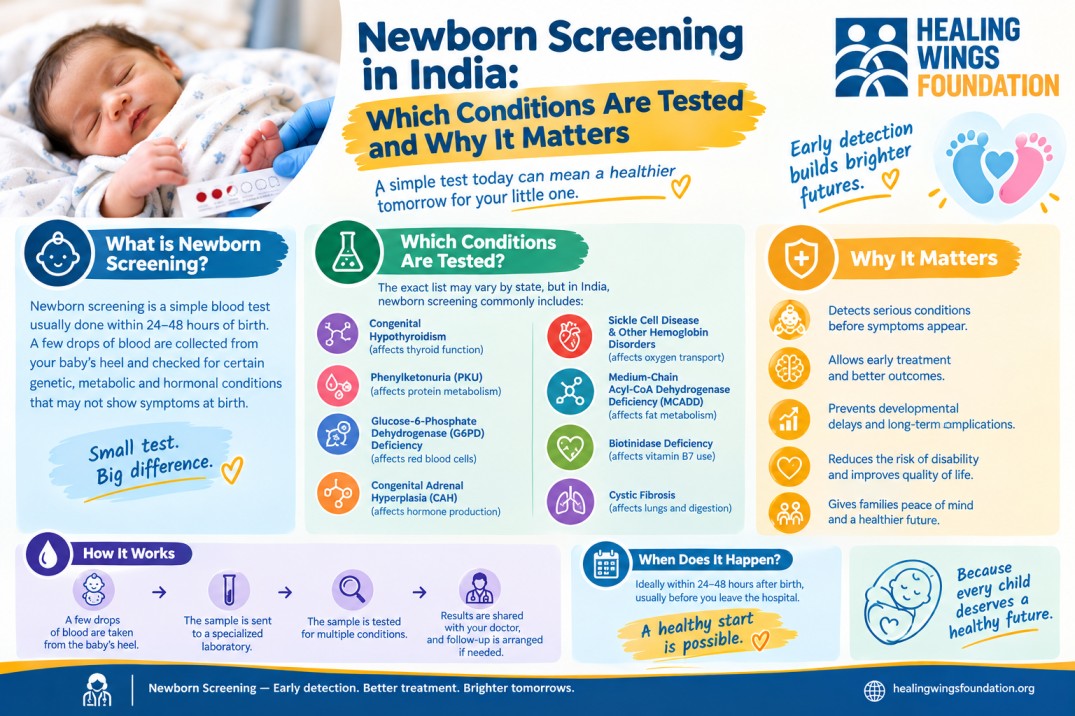
A few days after a baby is born, a tiny blood sample from the heel can reveal conditions that show no signs at birth but can cause serious, lasting harm if they go untreated. This is newborn screening. For many conditions, treatment started in the first weeks of life can prevent disability or save a life. In India, though, whether your baby is screened, and for what, depends on where the baby is born. This guide explains what is tested, what isn’t, and what parents can do. It is also a good example of why early diagnosis matters.
What is newborn screening?
Newborn screening is a set of simple tests done soon after birth to find babies who may have a serious but treatable condition. It is a screening test, not a diagnosis. A positive screen means “needs more testing,” not “your baby has the condition.” Confirmatory tests follow, and many babies who screen positive turn out to be fine.
Most screening uses a few drops of blood from the baby’s heel, dried on a special card (a dried blood spot). Some programmes also include a hearing test and a heart screening.
Which conditions are tested in India?
Here is the important point: India does not yet have one universal national newborn screening programme. The sources we reviewed describe a patchwork of state programmes, pilot projects, and hospital-based or private screening, and the list of conditions varies.
The conditions most often included are:
Congenital hypothyroidism (CH): the thyroid doesn’t make enough hormone. Untreated, it can cause intellectual disability and poor growth. Daily thyroid hormone tablets started early let children develop normally. Experts describe it as the commonest preventable cause of intellectual disability.
Congenital adrenal hyperplasia (CAH): a hormone disorder that can cause dangerous salt loss and collapse in the first weeks of life. It is treatable with medicines.
G6PD deficiency: an enzyme deficiency that can cause severe jaundice and breakdown of red blood cells when triggered by certain medicines or foods. Management centres on avoiding triggers.
Some programmes and pilot studies also screen for:
Galactosemia: the body can’t process milk sugar. A special lactose-free formula is life-saving.
Biotinidase deficiency: treated with a simple vitamin supplement.
Phenylketonuria (PKU) and other amino acid disorders: managed with a special diet.
Cystic fibrosis, in a few programmes.
Larger “expanded” panels use a technology called tandem mass spectrometry to check for dozens of metabolic conditions from one blood spot. These are mostly available in private labs and some tertiary hospitals.
Other newborn checks
Newborn screening is more than the blood test. Depending on the hospital, your baby may also have:
Hearing screening, to find hearing loss early, when speech and language development can still be protected
Pulse oximetry, a painless oxygen check used to screen for critical heart defects
A physical examination for visible birth defects
India’s Rashtriya Bal Swasthya Karyakram (RBSK) child health programme includes early identification of birth defects and developmental problems, though it is separate from blood-spot screening.
What is the national picture?
Public programmes have been run in places such as Goa, Kerala, and Chandigarh, with different lists of conditions.
A 2018 task force of the Indian Council of Medical Research recommended screening for congenital hypothyroidism and congenital adrenal hyperplasia.
Pilot studies, including one in Udupi, Karnataka, and a feasibility study in Delhi, have examined whether a national programme is workable and cost-effective.
Experts continue to call for a phased national rollout, starting with the most common treatable conditions.
Because policies change, ask your hospital what it currently offers rather than assuming.
Why timing matters
Many of these conditions look normal at birth. By the time symptoms appear, such as delayed development, repeated illness, or a sudden crisis, some damage may already be done. Screening within the first days of life lets treatment begin before that happens. It is a clear example of the benefit of early diagnosis of rare diseases, and why we work for rare disease advocacy and better access for every child.
What parents can do
Ask before delivery. Ask your doctor or hospital: Is newborn screening done here? Which conditions? Is it included in the bill or optional?
Ask about timing. The sample is usually collected from the heel in the first few days of life. If your baby is discharged early or born at home, ask where and when to get it done.
Don’t skip it because the baby looks healthy. Affected babies often look perfectly well.
Ask how results are shared. Find out who will contact you and how quickly, especially if a repeat test is needed.
If the screen is positive, act fast. Follow the follow-up instructions immediately and see a pediatrician or specialist. Don’t wait and see.
Keep the report. It is part of your child’s health record.
If it wasn’t done, ask about it. Many conditions can still be tested for later, so speak to your pediatrician.
A normal result isn’t a guarantee
Newborn screening covers only a limited list of conditions. A normal result does not rule out all genetic or metabolic disorders. If your child later has developmental delay, seizures, poor feeding, unusual tiredness, or loses skills, talk to your doctor even if the newborn screen was normal. A genetics evaluation may be the next step. See our genetic testing guide for the options.
Next steps for families
Ask your hospital which newborn screening tests it offers.
Make sure your baby has the heel-prick test, hearing screen, and heart check where available.
Share any family history of metabolic, thyroid, or genetic conditions with your doctor.
Reach out to our patient advocacy support team if you need guidance after an abnormal result.
References
Kapoor S, Kabra M. Newborn screening in India: current perspectives. Indian Pediatrics. 2010. indianpediatrics.net
Kaur et al. Current and future perspective of newborn screening: an Indian scenario. Journal of Pediatric Endocrinology and Metabolism. doi:10.1515/jpem-2015-0009
Need and viability of newborn screening programme in India: report from a pilot study. International Journal of Neonatal Screening. 2022;8(2):26. mdpi.com
Charting the course: towards a comprehensive newborn screening program in India. International Journal of Neonatal Screening. 2024;10(3):43. mdpi.com
National newborn screening program: still a hype or a hope now? Indian Pediatrics. 2013. indianpediatrics.net
Newborn screening for inborn errors of metabolism in India: present status, gaps and future directions. Indian Journal of Practical Pediatrics. 2025. ijpp.in
This article is for general education and isn’t a substitute for medical advice. Please talk with your baby’s doctor about screening and your specific situation.
