Watching a child grow and hit milestones — a first smile, first word, first steps — is one of the quiet joys of parenting. So when a child seems to lag behind in reaching those milestones, it's natural for parents to feel worried and want answers quickly.
Developmental delay is common, and it has many possible causes, ranging from environmental and prematurity-related factors to genetic conditions. For some children, genetic testing for developmental delay becomes part of the diagnostic workup. But genetic testing is not automatically recommended for every child with a delay — it is a decision a pediatrician or specialist makes based on a careful, individualized evaluation.
This article explains, in plain language, when genetic testing may be considered, what it can and cannot tell you, and how families can work with their care team to understand next steps. If your child has already been referred for a broader workup, our guide on developmental delay in children may also be a helpful starting point.
What Is Genetic Testing?
Genetic testing looks at a person's DNA — the genetic material inherited from both parents — to check for changes (called variants or mutations) that may explain certain health conditions, including some causes of developmental delay.
In the context of a developmental evaluation, genetic testing is generally used to help answer one question: is there an identifiable genetic cause contributing to this child's delay?
It's worth understanding a few basics up front:
Genetic testing is a medical tool, not a single test. There are many different types, each designed to detect different kinds of genetic changes.
Testing is typically ordered and interpreted by, or in consultation with, a physician or genetic counselor.
A genetic test result is one piece of a larger clinical picture — it's interpreted alongside a child's history, physical exam, and other findings, not in isolation.
Genetic testing for children with developmental delay is one part of a broader evaluation that may also include hearing and vision screening, developmental and behavioral assessment, and sometimes neuroimaging or metabolic testing, depending on the child's presentation.
Why Might Genetic Testing Be Considered for Developmental Delay?
Developmental delay — meaning a child is not reaching expected milestones in areas like motor skills, speech and language, cognition, or social skills — has a wide range of possible underlying causes. These include prematurity, birth complications, environmental exposures, hearing or vision impairment, psychosocial factors, and genetic conditions.
Research suggests that genetic factors contribute to a meaningful share of developmental delay and intellectual disability cases, though estimates vary depending on the population studied and how thoroughly children are evaluated. Because of this, professional guidelines from organizations such as the American Academy of Pediatrics (AAP) and the American College of Medical Genetics and Genomics (ACMG) support considering genetic testing as part of the diagnostic evaluation for children with unexplained global developmental delay or intellectual disability.
Genetic testing may be considered because it can, in some cases:
Help identify or confirm an underlying diagnosis
Inform understanding of prognosis and expected course
Guide surveillance for medical issues associated with a specific condition (for example, heart, kidney, or hearing concerns linked to certain syndromes)
Support more informed genetic counseling for future pregnancies
Connect families to condition-specific resources, research, or support communities
It's important to state clearly: not every child with developmental delay needs genetic testing. The decision depends on the child's individual clinical picture — their history, physical examination findings, family history, and the judgment of the evaluating physician or genetic specialist. Some delays have a clear, non-genetic explanation (such as prematurity or an identified injury), in which case genetic testing may not add useful information.
Signs or Clinical Findings That May Lead to Genetic Evaluation
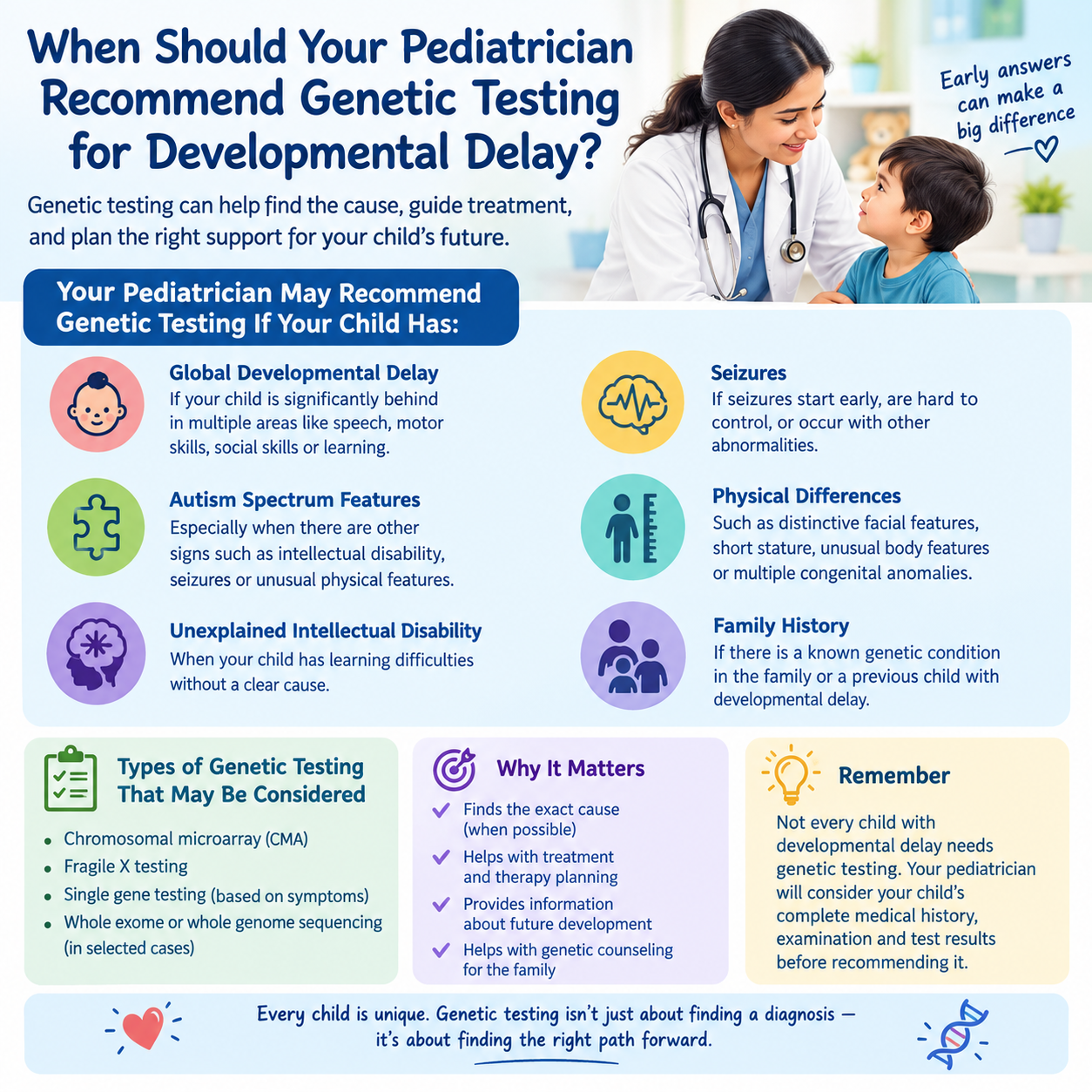
Pediatricians and specialists weigh several factors when deciding whether to refer a child for genetic evaluation or testing. No single sign automatically triggers testing, but the following findings, especially in combination, may prompt a doctor to consider it:
Global developmental delay — delay affecting two or more developmental domains (for example, both motor and language skills), rather than an isolated delay in one area
Regression — loss of previously acquired skills
Dysmorphic features — unusual facial or physical features noted on exam
Congenital anomalies — structural differences present at birth, such as heart defects or limb differences
Microcephaly or macrocephaly — head size significantly smaller or larger than expected
Seizures or other neurological findings
Growth abnormalities, including unusual growth patterns or failure to thrive
Family history of developmental delay, intellectual disability, unexplained infant deaths, or known genetic conditions
Consanguinity (parents who are closely related), which can increase the likelihood of certain inherited conditions
Lack of an identified cause after initial evaluation (for example, no history of prematurity, birth injury, or infection that would otherwise explain the delay)
Again, these are factors a clinician considers together, not a checklist where any single item mandates testing. Early developmental concerns are also worth discussing with your pediatrician as part of routine care — our article on early diagnosis discusses why timely evaluation matters, regardless of the eventual cause.
What Types of Genetic Tests May Be Considered?
If a doctor decides that genetic testing for developmental disorders is appropriate, there are several types of tests that may be used, sometimes in a stepwise fashion and sometimes together. Common categories include:
Chromosomal Microarray Analysis (CMA) Looks for missing or extra pieces of chromosomes (called copy number variants). This has traditionally been offered as a first-line test for unexplained developmental delay.
Fragile X Testing A specific test for Fragile X syndrome, one of the more common inherited causes of intellectual disability, particularly considered when there is a suggestive family history or clinical features.
Karyotype An older, broader test that looks at the number and structure of chromosomes; still used in specific clinical scenarios.
Single-Gene or Gene Panel Testing Looks at one gene or a curated group of genes associated with a suspected condition, used when a child's features point toward a specific diagnosis or category of conditions.
Exome Sequencing (ES) and Genome Sequencing (GS) Broader tests that examine most or all of the protein-coding genes (exome) or the entire genome. Several major medical societies, including the ACMG, now support exome or genome sequencing as a first- or second-tier test for children with developmental delay, intellectual disability, or multiple congenital anomalies, particularly when the cause isn't suggested by a specific pattern of features.
Metabolic Testing Not a genetic test in the strictest sense, but often performed alongside genetic testing, since some metabolic disorders overlap with genetic causes of delay and some are treatable.
The right test — or combination of tests — depends heavily on the individual child. This is part of why genetic testing for rare diseases is typically guided by a specialist rather than ordered as a routine, one-size-fits-all panel.
How Doctors Decide Which Genetic Test Is Appropriate
Choosing a genetic test isn't a matter of ordering "the genetic test" — it involves clinical reasoning. Physicians and genetic counselors generally consider:
The child's specific pattern of findings. If a child's features strongly suggest a particular syndrome, targeted testing for that condition may be tried first.
Whether the delay is isolated or global, and whether other body systems are involved.
Family history, including any known genetic conditions or patterns of inheritance.
Prior test results. If earlier testing (such as a microarray) was uninformative, broader testing like exome or genome sequencing may be the next step.
Availability, cost, and insurance coverage, which can influence sequencing versus more targeted options.
Turnaround time and clinical urgency — for example, a child in the NICU with a serious anomaly may need faster answers than a child being followed for a mild delay.
This is typically a collaborative decision between the pediatrician, a clinical geneticist or genetic counselor, and the family — and it may evolve over time as results come back or as a child's clinical picture develops. For background on how this decision-making process fits into a broader diagnostic journey, see our related article on genetic testing for rare disease.
What Happens Before Genetic Testing?
Genetic testing for developmental delay is rarely the very first step. Before ordering a test, a physician will typically:
Take a detailed history, including pregnancy, birth, developmental milestones, and family medical history across multiple generations
Perform a thorough physical and neurological examination, looking for dysmorphic features, skin findings, growth patterns, or neurological signs
Review or order developmental screening and assessment to characterize the delay's severity and which domains are affected
Rule out or address non-genetic contributors, such as hearing or vision problems, which can sometimes look like developmental delay
Refer to a specialist, such as a developmental pediatrician, pediatric neurologist, or clinical geneticist, when appropriate
Discuss genetic counseling with the family, so parents understand what a given test can and cannot tell them, the possible results, and how the information might be used
Genetic counseling before testing is an important step. It gives families a chance to ask questions, understand the scope of the test being considered, and think through how they might feel about different possible outcomes — including uncertain or unexpected findings.
What Can Genetic Test Results Show?
It's important for parents to have realistic expectations about what genetic testing can and cannot provide. Possible outcomes generally fall into a few categories:
A positive (diagnostic) result — A genetic change is identified that is known to explain the child's developmental delay. This can provide clarity, guide medical management and surveillance, and inform family planning discussions.
A negative result — No disease-causing genetic change is found on the test performed. This does not necessarily rule out a genetic cause altogether; it may mean the specific test used wasn't able to detect the underlying change, or that the cause isn't genetic at all.
A variant of uncertain significance (VUS) — A genetic change is found, but it isn't yet clear whether it is responsible for the child's symptoms. These findings often require further research, family testing, or time before their meaning becomes clearer.
An incidental or secondary finding — Occasionally, broader tests like exome or genome sequencing uncover genetic information unrelated to the original reason for testing, which may have its own implications.
No genetic test can guarantee a diagnosis. Even with advanced sequencing technology, a substantial number of children with developmental delay will not receive a definitive genetic answer, at least not with current testing methods. This doesn't mean the evaluation was unnecessary — ruling things out, however imperfectly, is still clinically useful information, and re-analysis of existing genetic data can sometimes yield answers years later as science advances.
What Happens After Genetic Testing?
What comes next depends on the result:
If a diagnosis is identified, the care team will typically discuss what is known about the condition, any recommended medical surveillance (for example, cardiac or hearing evaluations), and connect the family with relevant specialists, support groups, or rare disease resources.
If the result is negative or uncertain, the child's care team may recommend continued developmental support and monitoring, consideration of additional or repeat testing in the future, or referral for further evaluation if new symptoms emerge.
Regardless of the genetic result, developmental support services — such as early intervention, speech therapy, occupational therapy, or physical therapy — generally continue based on the child's individual needs, not solely on whether a genetic cause was found.
Families are also often offered ongoing genetic counseling, which can help interpret new information as it becomes available, including updated interpretations of uncertain variants.
Questions Parents Can Ask Their Doctor
If genetic testing is being discussed for your child, consider asking:
Why is this specific test being recommended for my child?
What could this test find, and what would it not be able to tell us?
How long will it take to get results, and how will they be explained to us?
What are the possible outcomes, including negative or uncertain results?
Will this test require a blood draw, saliva sample, or other procedure?
Could this result affect other family members, and should they be tested too?
Will insurance cover this test, and what are the potential costs?
What happens next, depending on the result?
Should we meet with a genetic counselor before or after testing?
There are no "wrong" questions here — understanding the purpose and limits of testing helps families make informed decisions alongside their care team.
Frequently Asked Questions
Does every child with developmental delay need genetic testing? No. Genetic testing is considered on a case-by-case basis, depending on a child's history, exam findings, and other clinical factors. Many children with developmental delay do not require genetic testing, particularly when another cause is already identified.
Is genetic testing recommended right after a delay is first noticed? Not usually. Doctors typically start with a developmental assessment, physical exam, and screening for common contributors like hearing or vision issues before considering genetic testing.
Can genetic testing tell us exactly what caused our child's delay? Sometimes, but not always. Genetic testing can identify a cause in some children, while others receive a negative or uncertain result. Testing is one tool among several used in a full evaluation.
How long does it take to get genetic test results? This varies by the type of test and laboratory, ranging from a couple of weeks for targeted tests to a couple of months for broader sequencing.
Will genetic testing change our child's treatment or therapy? In some cases, an identified genetic diagnosis can guide medical surveillance or specific management. In many cases, recommended therapies (such as speech or occupational therapy) are based on the child's functional needs and continue regardless of genetic findings.
Is genetic testing only useful for very rare conditions? Genetic testing is often discussed in the context of rare diseases because many genetic causes of developmental delay are individually uncommon. However, testing may still be considered even when no specific rare condition is suspected, if a doctor feels it could add useful information.
Medical Disclaimer
This article is intended for general educational purposes only and does not constitute medical advice. It is not a substitute for professional medical evaluation, diagnosis, or treatment. Decisions about genetic testing should always be made in consultation with a qualified healthcare provider, such as a pediatrician, developmental specialist, or clinical geneticist, who can assess your child's individual circumstances. If you have concerns about your child's development, please contact your healthcare provider.
References
Rodan LH, Stoler J, Chen E, et al. Genetic Evaluation of the Child With Intellectual Disability or Global Developmental Delay: Clinical Report. Pediatrics, American Academy of Pediatrics.
View on AAP PediatricsManickam K, McClain MR, Demmer LA, et al. Exome and genome sequencing for pediatric patients with congenital anomalies or intellectual disability: An evidence-based clinical guideline of the ACMG. Genetics in Medicine. 2021;23(11):2029–2037.
View on PubMedMoeschler JB, Shevell M; Committee on Genetics. Comprehensive evaluation of the child with intellectual disability or global developmental delays. Pediatrics. 2014;134(3):e903–e918.
View on PubMedMichelson DJ, Shevell MI, Sherr EH, et al. Evidence report: Genetic and metabolic testing on children with global developmental delay. Neurology. 2011;77(17):1629–1635.
View on PubMedSrour M, Shevell M. Genetics and the investigation of developmental delay/intellectual disability. Archives of Disease in Childhood. 2014;99(4):386–389.
View on PubMedAmerican College of Medical Genetics and Genomics (ACMG). Chromosomal microarray in the clinical genetic evaluation of individuals with developmental delay, intellectual disability, or autism spectrum disorders.
Visit ACMG
