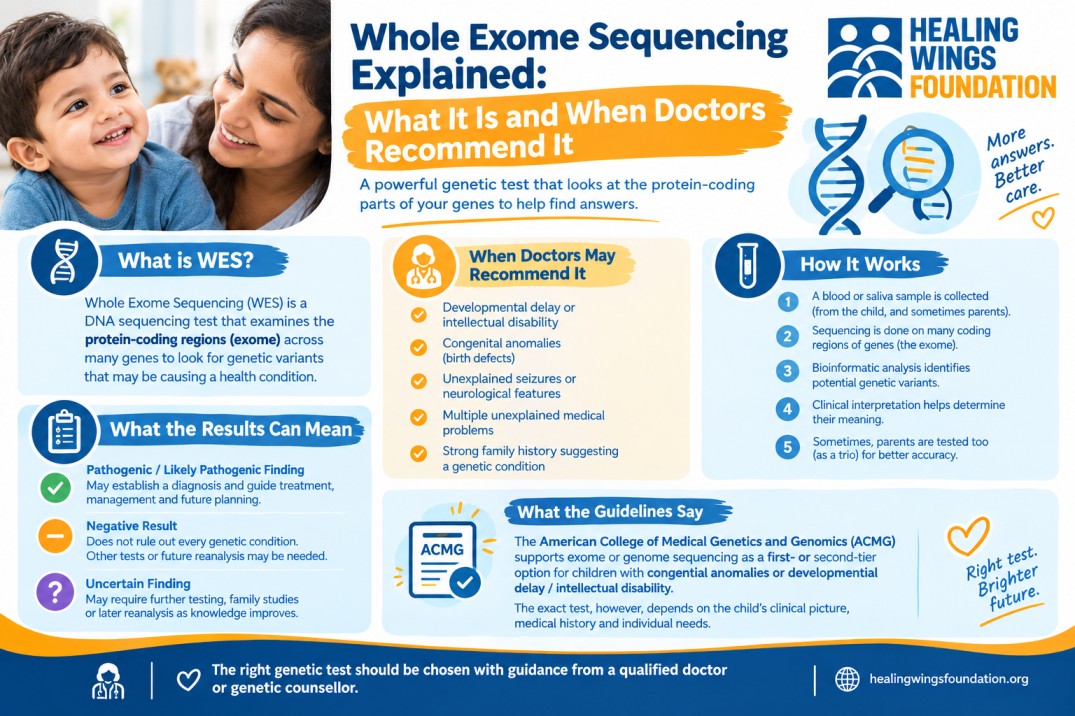
When a child has unexplained developmental delay, seizures, multiple birth differences, or a condition that runs in the family, doctors often start with simpler tests. If those don’t give an answer, the next step may be whole exome sequencing (WES). The name sounds technical, but the idea is simple, and understanding it can help you ask better questions and make confident decisions. It is one of the most useful tools for early diagnosis of rare genetic conditions.
What is the exome?
Your DNA contains about 20,000 genes. The instructions in these genes are written in sections called exons, which tell the body how to build proteins. All the exons together make up the exome.
The exome is only about 1 to 2 percent of your total DNA, but it contains a large share of the changes known to cause genetic disease. That is why reading it is an efficient way to look for answers.
What is whole exome sequencing?
Whole exome sequencing is a test that reads the exons of nearly all genes in one go. A lab captures these regions from a blood or saliva sample, reads the DNA letter by letter, and compares it with a reference to find changes (variants). Specialists then work out which, if any, of these changes could explain the person’s condition.
Think of the genome as a huge encyclopedia. A single-gene test checks one page. A gene panel checks a chapter. Exome sequencing reads the important text of every chapter, though not every footnote.
How it differs from other tests
Single-gene test: looks at one gene when the diagnosis is already strongly suspected.
Gene panel: looks at a chosen group of genes, such as those linked to epilepsy.
Chromosomal microarray: detects missing or extra pieces of chromosomes. It is often done first in children with developmental delay or birth differences.
Whole exome sequencing: reads the protein-coding genes broadly, with no need to guess the gene first.
Whole genome sequencing: reads nearly all DNA, including regions between genes.
For a full comparison, see our genetic testing guide for patients and families.
When do doctors recommend it?
Your doctor or geneticist may suggest exome sequencing when:
A child has developmental delay or intellectual disability with no clear cause, especially after a microarray is normal
Seizures start in infancy or don’t respond to medicines
There are multiple health problems affecting different body systems
The condition could be caused by many different genes, so testing one gene at a time would be slow
A specific syndrome is suspected but single-gene or panel tests were negative
The family has several affected members, or parents are related by blood
A child is critically ill and a fast diagnosis could change care
Earlier tests gave no answer and the diagnostic journey has gone on for years
An Indian review of genomic testing in children notes that sequencing tests end the diagnostic odyssey in roughly 25 to 30 percent of unselected children with rare single-gene conditions. The chance is higher when the doctor chooses carefully who to test.
What happens during testing?
Consultation and counselling. A doctor or genetic counsellor explains the purpose, possible results, and limits of the test, and you give consent.
Sample collection. Usually a small blood sample, sometimes saliva.
Parents may be tested too. Testing the child and both parents together (called trio testing) helps show whether a change is new in the child or inherited, and makes the result easier to interpret.
Lab analysis. DNA is sequenced and analysed. Results often take several weeks.
Report and follow-up. A specialist reviews the findings with you and explains what they mean for care and for the family.
What can the results say?
Positive (pathogenic variant found): a genetic cause has been identified. This may guide treatment, monitoring, and planning, and help relatives understand their own risk.
Negative (no cause found): this does not mean the condition isn’t genetic. The test may have missed it, or the gene may not be linked to disease yet. Results can be reanalysed later as knowledge grows.
Uncertain (variant of uncertain significance): a change was found but science can’t yet say whether it causes the condition. This is common and can be frustrating. Parental testing or later reanalysis can sometimes settle it.
Additional findings: occasionally a test reveals an unrelated health risk. Ask before testing whether and how such findings will be reported.
What exome sequencing can’t do
Exome sequencing is powerful but not complete. It may miss:
Changes in DNA outside the protein-coding regions
Some large deletions or duplications (a microarray may catch these)
Repeat-expansion conditions, such as fragile X, which need special tests
Changes in some difficult-to-read regions of DNA
This is why doctors often combine tests, or move to genome sequencing if exome sequencing finds nothing.
Questions to ask your doctor
Why is exome sequencing the right test now, rather than a panel or microarray?
Should the parents be tested as well?
How long will results take, and who will explain them?
Will the lab reanalyse the data if the first result is negative?
How will additional or unexpected findings be handled?
What are the costs, and is any part covered by insurance?
How technology is changing diagnosis
Sequencing is only one part of the picture. Computer tools now help specialists sort through thousands of variants and match a child’s symptoms to rare conditions faster. Read how in our article on AI in genetic disorder recognition, and explore our work in research and innovation.
Next steps for families
Keep a record of symptoms, milestones, and earlier test results.
Ask your child’s doctor for a referral to a genetics clinic or genetic counsellor.
Prepare your family history, including relatives with similar problems.
Ask for written information about the test, costs, and what happens to the data.
Remember that a result, whatever it is, is a starting point for support and planning.
References
Narayanan DL, Girisha KM. Genomic testing for diagnosis of genetic disorders in children: chromosomal microarray and next-generation sequencing. Indian Pediatrics. 2020;57(6):549-554. doi:10.1007/s13312-020-1853-3
Genomic diagnosis for pediatric disorders: revolution and evolution. Frontiers in Pediatrics. 2020;8:373. doi:10.3389/fped.2020.00373
Clinical utility of proband-only clinical exome sequencing in neurodevelopmental disorders. Indian Journal of Pediatrics. 2023. PMID 37943464
This article is for general education and isn’t a substitute for medical advice. Please talk with your child’s healthcare team about your specific situation.
Links used: early-diagnosis, research-innovation, genetic-testing-guide-patients-families, ai-early-recognition-genetic-disorders. I also left out the other pages you didn’t list.
Please check before publishing:
The exome is described as about 1 to 2 percent of DNA, which is the commonly cited figure, but I didn’t verify it against a specific source. Reference 2 is a good place to confirm it. The 25 to 30 percent figure comes from reference 1.
References 2 and 3 still need author names added from their pages.
I didn’t link to the cost post because it wasn’t in your list. If you want to, add this line under “Questions to ask your doctor”: “For a breakdown of prices, see genetic testing cost in India.” Check the slug matches what you published.
