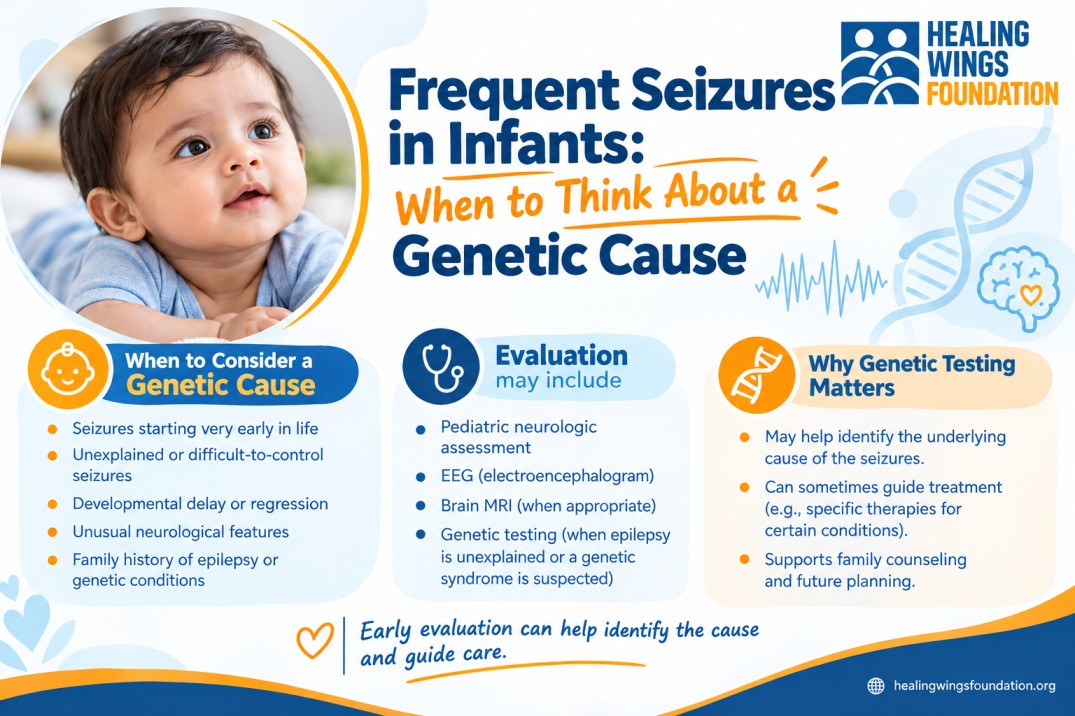
Watching your baby have a seizure is frightening, and when the seizures keep coming, the questions multiply. Why is this happening? Will medication work? Is there something we’re missing? For a growing number of infants, the answer is a change in a single gene. Knowing when to look for one can shorten the path to the right treatment, which is why early diagnosis matters so much in rare diseases.
Not every seizure points to a genetic cause
Infant seizures have many causes: birth-related injury, infection, low blood sugar, structural brain differences, or a simple febrile seizure that never returns. A single short seizure with fever in an otherwise thriving child is rarely a reason for extensive testing. The picture changes when seizures are frequent, hard to control, or accompanied by other concerns.
Signs that a genetic cause is worth discussing
Ask your child’s neurologist about genetic testing if you notice any of the following:
Seizures starting in the first year of life, especially in the first six months
Seizures that don’t respond to two or more anti-seizure medications
Developmental delay or loss of skills such as smiling, babbling, rolling, or eye contact (learn the difference in developmental delay vs. developmental regression)
Infantile spasms: sudden clusters of head-nodding, arm-flinging, or body-folding movements, often on waking. These need urgent medical attention.
Multiple seizure types in the same child
Long or one-sided seizures triggered by fever or a warm bath
Low muscle tone, feeding difficulties, or unusual movements alongside seizures
A family history of epilepsy, developmental disability, or unexplained infant death, or parents who are related by blood
Brain MRI or EEG findings that suggest a specific syndrome, or no clear cause found at all
If your child is also not meeting developmental milestones, mention this to the doctor along with the seizures. Together they make the case for testing stronger.
Examples of genetic epilepsies in infants
Hundreds of genes are now linked to early-onset epilepsy. A few well-known examples:
SCN1A (Dravet syndrome): prolonged, fever-sensitive seizures often starting around six months in a previously healthy baby
CDKL5 deficiency disorder: very early seizures, often with significant developmental challenges
STXBP1, KCNQ2, SCN2A: early-onset epilepsies with a range of severity
TSC1/TSC2 (tuberous sclerosis complex): a common genetic cause of infantile spasms
SLC2A1 (GLUT1 deficiency): seizures that may improve dramatically with a ketogenic diet
Seizures are one of many signs in this group. See our overview of rare diseases that cause developmental delay for more.
Why a diagnosis matters
A genetic diagnosis is more than a label. It can:
Guide treatment. Some therapies work better for specific conditions, and some medications can make certain syndromes worse. In Dravet syndrome, for instance, sodium channel blockers are generally avoided.
Give a clearer outlook, helping you plan for therapies, school, and support.
Inform family planning and let relatives know whether they are at risk.
End the diagnostic odyssey and connect you with other families and condition-specific communities. Many families wait years for answers, as we explain in why rare diseases are difficult to diagnose.
What testing involves
Testing is usually done with a simple blood or saliva sample. Common options include:
Epilepsy gene panels, which look at known seizure-related genes
Exome or genome sequencing, a broader search, often used when a panel finds nothing
Chromosomal microarray, which detects missing or extra pieces of chromosomes
A genetic counselor can explain what each test can and cannot reveal, and what the results might mean for your family. A negative result doesn’t rule out a genetic cause, since science is still discovering new genes, and results can be reanalyzed over time. For a full walkthrough, read our genetic testing guide for patients and families and when to consider genetic testing.
Next steps for families
Keep a seizure diary, with short videos if possible, noting timing, triggers, and duration.
Ask your pediatric neurologist or epileptologist whether genetic testing is appropriate now.
Request a referral to a genetics clinic or genetic counselor.
Seek urgent care for suspected infantile spasms, seizures lasting more than five minutes, or breathing difficulty.
Don’t hesitate to speak up for your child. Our guide to patient advocacy in rare diseases can help.
After the diagnosis
A diagnosis is the start of a new phase, not the end of the road. Read what to expect after a rare disease diagnosis, and explore our resources on care for rare diseases and patient advocacy support. If you’re in India, see rare diseases in India for local context. Need help? Contact our team.
This article is for general education and isn’t a substitute for medical advice. Please talk with your child’s healthcare team about your specific situation.
References
Scheffer IE, Berkovic S, Capovilla G, et al. ILAE classification of the epilepsies: Position paper of the ILAE Commission for Classification and Terminology. Epilepsia. 2017;58(4):512-521.
Wirrell EC, Nabbout R, Scheffer IE, et al. Methodology for classification and definition of epilepsy syndromes with list of syndromes: Report of the ILAE Task Force on Nosology and Definitions. Epilepsia. 2022;63(6):1333-1348.
Sheidley BR, Malinowski J, Newman EA, et al. Genetic testing for the epilepsies: A systematic review. Epilepsia. 2022;63(2):375-387.
Wirrell EC, Laux L, Donner E, et al. Optimizing the diagnosis and management of Dravet syndrome: Recommendations from a North American consensus panel. Pediatric Neurology. 2017;68:18-34.
Go CY, Mackay MT, Weiss SK, et al. Evidence-based guideline update: Medical treatment of infantile spasms. Neurology. 2012;78(24):1974-1980.
Northrup H, Aronow ME, Bebin EM, et al. Updated international tuberous sclerosis complex diagnostic criteria and surveillance and management recommendations. Pediatric Neurology. 2021;123:50-66.
Klepper J, Akman C, Armeno M, et al. Glut1 deficiency syndrome (Glut1DS): State of the art in 2020 and recommendations of the international Glut1DS study group. Epilepsia Open. 2020;5(3):354-365.
